Skip to content
By Janet H., Owner, Janet Media GroupPublished How we research

Safety

Car seat vs baby carrier

One is crash protection. The other is a way to carry a baby. Confusing them is the most common unsafe-sleep mistake parents make.

An infant car seat carrier beside a soft baby carrier

Buckle & Buggy earns a commission when you buy through links on this page, at no extra cost to you. It does not change what we recommend or the order we rank things in — the criteria are published on our review methodology page, and the full terms are in our affiliate disclosure.

The direct answer

A car seat is crash protection for travel in a vehicle; a baby carrier is a way to carry a baby on your body. They are not substitutes for each other, and neither is a place for a baby to sleep. In a car you must use a car seat — a sling or soft carrier provides no crash protection and is never a restraint. Out of the car, a carrier is often the better choice precisely because it gets the baby out of the semi-upright car seat.

The confusion is understandable, because an infant car seat has a handle and gets carried. But the handle exists to move the baby between the car and the stroller, not to serve as a travel cot. Pediatric guidance treats a car seat as transport rather than as a sleep space, and that guidance does not change when the seat is clipped onto a stroller or set on the floor.

What each one is designed to do

Car seat against baby carrier, by job
Infant car seatBaby carrier or sling
In a vehicleRequired. The only legal and safe optionNever. No crash protection at all
Walking and errandsWorkable on a stroller frame, but semi-uprightIts purpose. Upright, supported, hands free
Airports and transitHeavy to carry far; FAA approval varies by modelExcellent — and stays on through security lines
SleepNot a sleep space. Transport onlyNot a sleep space. Supervised carrying only
Airway positionSemi-upright; head can fall forward when asleepUpright, chin off chest, face visible
Time limitsKeep vehicle time short and break up long tripsNo fixed limit, but check position constantly

The airway row is the one that matters most. A newborn's neck control is minimal, and in a semi-upright seat a sleeping baby's head can fall forward onto the chest, narrowing the airway. That is the reason for the time cautions on car seats, set out in full in how long a baby can stay in a car seat.

Using a carrier safely

A carrier is safe when the baby's position is right and unsafe when it is not, and the difference is easy to see once you know what to look for.

  • Face visible at all times. Nothing covering the baby's face, no fabric pressed against it, no chin tucked down into the chest.
  • Close enough to kiss. The baby's head should be high on your chest, not down at your waist, where the airway bends.
  • Chin off the chest. A finger's width of space under the chin. This is the single most important check with a newborn.
  • Supported back, knees higher than the bottom. A curved supported spine with the legs in an M shape, not dangling straight down.
  • Check after every adjustment. Slings loosen as you walk, and a loosened sling drops the baby lower.

The same unsafe-sleep logic applies to both devices: a baby who falls asleep in a carrier or a car seat outside the car should be moved to a firm flat surface when it is practical. Neither is a crib.

Which infant car seat, if you want both

Most parents end up using both, which makes the car seat choice about the car and the carrier choice about your back. Three car seats that suit different versions of that pattern:

01 — Most newborns

Chicco KeyFit 35

Chicco

No image
Our score8.8
Install9.4
Fit range8.6
Vehicle fit8.8
Daily use8.2
Value9.2
Check price on Amazon

#ad We may earn a commission · Amazon shows the current price

The infant seat we would hand a first-time parent: a 4 lb minimum, a bubble level and a belt-tensioning system that makes a correct install hard to get wrong.

The KeyFit line has been the default recommendation in this category for years, and the 35 is the version worth buying because the taller shell buys you months of extra use over the older KeyFit 30. It starts at 4 lb with the newborn positioner, which covers most preemie discharges, and tops out at 35 lb or 32 in — and like every infant seat, height is what your baby will actually hit first. What earns it the top slot is install feel rather than any spec: the base has a bubble level for the recline angle and a belt-tightening mechanism you crank rather than yank, so getting under the one-inch movement limit does not take three attempts. The trade-off is that the carrier is on the heavier side of the category and the canopy is smaller than the premium seats below. If you want the lowest-chemical version, the ClearTex fabrics carry no added flame retardants.

What works

  • Starts at 4 lb, so it fits most newborns straight out of hospital
  • Bubble level plus a cranking belt tightener makes a tight install repeatable
  • Tall shell gets you closer to the 32 in limit than the older KeyFit 30
  • ClearTex versions drop the added flame retardants

What to weigh

  • Carrier is heavier than the premium lightweight seats
  • Canopy is small next to Nuna or UPPAbaby
  • No load leg or anti-rebound bar at this price
Published specifications for the Chicco KeyFit 35, with the source each figure was read from
SpecPublished figureRead from
Rear-facing range4-35 lb, up to 32 inChicco product page
Newborn positionerRequired 4-11 lbChicco product page
HarnessNo-rethread, Easy-Extend headrestChicco product page
Fabric optionClearTex — no added flame retardantsChicco product page

Verified as currently sold and checked against NHTSA's recall record on 2026-09-26; no recall named this model. Recalls apply to specific manufacture-date ranges, so check the date stamp on your own unit. We do not print a star rating for this seat: NHTSA publishes an Ease-of-Use rating, and we would rather send you to the source than reprint a figure we could not read first-hand. Specifications come from the manufacturer or retailer listing.
02 — Most crash-management hardware

Nuna PIPA RX with RELX base

Nuna

No image
Our score8.9
Install9.6
Fit range8.2
Vehicle fit9.0
Daily use9.4
Value6.4
Check price on Amazon

#ad We may earn a commission · Amazon shows the current price

The infant seat with the most structural hardware in the category — steel load leg, anti-rebound panel and rigid LATCH — and the lightest carrier of the seats we looked at.

Two things separate the PIPA RX from cheaper seats, and neither is marketing. The first is the load leg: a steel strut that braces from the base to the vehicle floor, which Nuna states reduces forward rotation by up to 90 percent. The second is rigid LATCH, which bolts the base to the anchors instead of tensioning a strap, so the install is essentially unambiguous. Add the anti-rebound panel and the RELX base's four recline positions and you have the seat that copes best with an awkward vehicle seat angle. The carrier is 7.6 lb, the lightest we recorded, which matters more than parents expect at month five. It is also one of the most expensive infant seats sold, and its 32 lb weight ceiling is lower than the KeyFit 35's — irrelevant in practice, because height runs out first. Note it also installs baseless with European belt routing, which makes it a genuine option for rideshares.

What works

  • Load leg plus anti-rebound panel is the most crash-management hardware in the category
  • Rigid LATCH removes most of the guesswork from the install
  • Lightest carrier we recorded at 7.6 lb
  • Four base recline positions handle steeply sloped vehicle seats

What to weigh

  • Among the most expensive infant seats on the market
  • 32 lb ceiling is lower on paper than several cheaper seats
  • Rigid LATCH bases do not fit every vehicle anchor layout
Published specifications for the Nuna PIPA RX with RELX base, with the source each figure was read from
SpecPublished figureRead from
Rear-facing range4-32 lb, up to 32 inNuna product page
Carrier weight7.6 lb without insert or canopyNuna product page
Base featuresSteel load leg, anti-rebound panel, rigid LATCH, 4 recline positionsNuna product page
Baseless installYes — European belt routingNuna product page

Verified as currently sold and checked against NHTSA's recall record on 2026-09-26; no recall named this model. Recalls apply to specific manufacture-date ranges, so check the date stamp on your own unit. We do not print a star rating for this seat: NHTSA publishes an Ease-of-Use rating, and we would rather send you to the source than reprint a figure we could not read first-hand. Specifications come from the manufacturer or retailer listing.

03 — City trips and airports

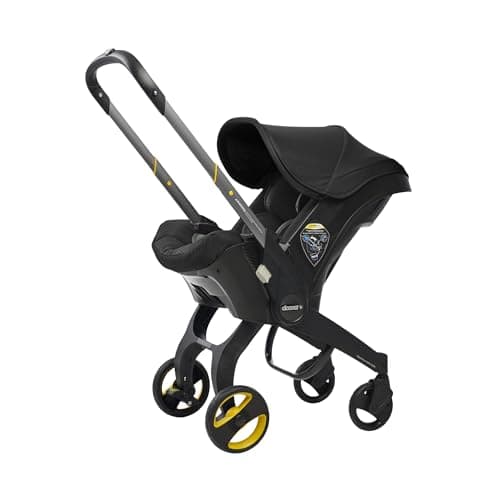
Doona+ Car Seat & Stroller

Doona

Doona+ Car Seat & Stroller
Our score8.4
Install8.4
Fit range7.6
Vehicle fit8.6
Daily use9.4
Value6.2
$550.00 · View on Amazon

#ad We may earn a commission · Price as of October 19, 2026

An infant seat whose wheels fold out of its own base, which is either the best purchase of your first year or an expensive mistake depending entirely on how you travel.

The Doona is one product doing two jobs: unfold the wheels and the car seat becomes a stroller, with no frame to lift out of a trunk. If your life is taxis, city sidewalks, airport gates and trips where a stroller frame is dead weight, nothing else does this. It is FAA approved for use on aircraft when installed baseless, which matters for the flying use case. The honest limits are the ones every Doona owner reports: it is 16.5 lb, which is heavy for a carrier you lift into a car, the storage basket is token, and the 4-35 lb / 32 in range means most babies outgrow it by height somewhere around a year — so you are buying a short-life product at a high price. It is also not a substitute for a real stroller if you do long walks. Buy it for the specific journey it solves, not as your only wheels.

What works

  • No stroller frame to carry, store or assemble
  • The best answer in this category for taxis, rideshares and airport gates
  • FAA approved for aircraft use without the base

What to weigh

  • 16.5 lb is heavy to lift in and out of a car
  • Outgrown by height at around a year, like any infant seat
  • Minimal storage, and not a real substitute for a full stroller
  • Premium price for a short-lived product
Published specifications for the Doona+ Car Seat & Stroller, with the source each figure was read from
SpecPublished figureRead from
Range4-35 lb, up to 32 inDoona product page
Weight16.5 lbDoona product page
Air travelFAA approved for aircraft use when installed baselessDoona product page

Verified as currently sold and checked against NHTSA's recall record on 2026-09-26; no recall named this model. Recalls apply to specific manufacture-date ranges, so check the date stamp on your own unit. We do not print a star rating for this seat: NHTSA publishes an Ease-of-Use rating, and we would rather send you to the source than reprint a figure we could not read first-hand. Specifications come from the manufacturer or retailer listing.

If the car seat will be carried any distance, weight is the specification that matters: the Nuna PIPA RX carrier is 7.6 lb without the insert or canopy, and the Chicco KeyFit 35 covers 4-35 lb up to 32 in with a required positioner for 4-11 lb. The Doona+ is the odd one out — at 16.5 lb it is heavy to carry by hand, but its wheels fold out of its own frame, so it is not meant to be carried. For the wider field see best infant car seats.

Frequently asked questions

Can I use a baby carrier instead of a car seat?

No. A sling or soft carrier offers no crash protection and is never a vehicle restraint. In a car, a baby must be in a car seat that fits them and is correctly installed. A carrier is for carrying a baby on your body outside the vehicle.

Is a car seat or a baby carrier better for a newborn?

For travel in a car, the car seat, with no alternative. Everywhere else a carrier is generally better for a newborn, because it holds them upright with the airway open rather than semi-upright, and it gets them out of the car seat — which pediatric guidance treats as transport rather than as a place to spend the day.

Can a baby sleep in a baby carrier?

Babies do fall asleep in carriers, and the position must be checked constantly when they do: chin off the chest, face visible, head high on your chest. A carrier is not a sleep space, so move the baby to a firm flat surface when it is practical. Overnight sleep belongs in a crib.

How long can a baby stay in an infant car seat?

Keep vehicle time short and break up long journeys with real breaks out of the seat, and do not use the seat as a day-long resting place outside the car. The concern is the semi-upright position and the airway, not the seat itself, which is why the caution applies on a stroller frame too.

Do I need both a car seat and a baby carrier?

Most families use both, because they do different jobs. If you drive at all you need the car seat. A carrier is optional but unusually useful for airports, transit, stairs, shops with narrow aisles and any situation where a stroller is more trouble than help.