
Skip to content
By Janet H., Owner, Janet Media GroupLast updated How we research

Safety

Do car seats expire?

Yes — and the date is on the seat, not in the paperwork. Here is where to look, why the window exists, and why you should not pass an expired seat on.

A date stamp label on the side of a child car seat shell

Buckle & Buggy earns a commission when you buy through links on this page, at no extra cost to you. It does not change what we recommend or the order we rank things in — the criteria are published on our review methodology page, and the full terms are in our affiliate disclosure.

The short answer

Car seats expire. Manufacturers set a useful-life period — commonly six to ten years from the date of manufacture, and sometimes longer for all-in-one seats designed to span every stage — and that date is printed or molded onto the seat itself.

Expiry is not a legal requirement in most of the country and no one will stop you using a seat past its date. It is the manufacturer's statement of the period over which they will stand behind the product, and past that point you are using a safety device outside the conditions its maker supports.

Where to find the date

There are usually two dates on a car seat and they are easy to confuse.

  1. 1.The date of manufacture — always present, on a white or silver label, and often also molded into the plastic of the shell or base. This is the date the useful life runs from.
  2. 2.The expiry or useful-life statement — sometimes an explicit expiry date, sometimes a phrase like *do not use after six years from date of manufacture* which you have to do the arithmetic on.

Where to look, in rough order of likelihood: the side of the shell; the underside of the seat or base; behind or beneath the fabric cover at the base of the shell; molded into the plastic near the belt path. If you cannot find it, the manual states the useful life, and the manufacturer's customer service will tell you given the model and manufacture date.

Why the window exists

Four reasons, and only one of them is about the plastic.

What a car seat expiry date is actually protecting against
ReasonWhat happens over time
Material degradationCar interiors cycle through extreme heat and cold and receive constant UV exposure. Polymers become more brittle, and webbing and foam degrade — all in ways that are not visible from outside.
Standards moveFederal requirements change. FMVSS 213a added a side-impact requirement, so a ten-year-old seat was certified against an older bar than a new one.
Parts availabilityManufacturers stop producing replacement covers, buckles and harnesses for old models. A seat you cannot get a correct part for is a seat you cannot properly repair.
Unknown historyOver a decade a seat accumulates unrecorded events: minor collisions, being dropped, being left in a hot trunk, being cleaned with the wrong chemicals.

None of these produce a seat that visibly fails on its expiry date. That is exactly why the date exists as a fixed rule rather than an inspection: the degradation it manages is the kind you cannot see.

What to do with an expired seat

Do not pass it on. Selling, gifting or donating an expired seat moves a product outside its supported life to someone who cannot assess it — and a charity or a thrift store buyer has no way to know. This is the same reasoning behind not gifting used seats at all, covered in secondhand car seat safety.

Instead, make it unusable before disposal: cut the harness straps, remove the cover, and mark the shell clearly as expired. Then check whether a trade-in event or a local recycling scheme will take it — several large retailers run periodic car seat trade-in programs, and some municipal recycling centers accept the plastic shells.

If the expired seat is the one your child is currently using, replacing it is the urgent job. The three seats below are the ones we would point you at as straightforward replacements for a seat that has timed out — one convertible, one all-in-one and one booster — chosen for long fit ranges so the next seat lasts as long as the window allows.

01 — Extended rear-facing

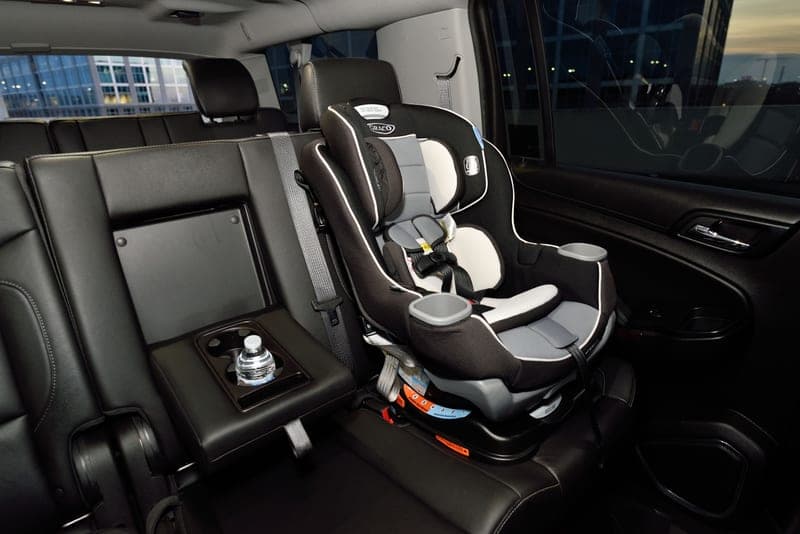
Graco Extend2Fit

Graco

A young child riding in a car seat — category photo, not this specific modelCategory photo
Our score8.9
Install8.6
Fit range9.6
Vehicle fit7.6
Daily use8.4
Value9.4
Check price on Amazon

#ad We may earn a commission · Amazon shows the current price

Rear-faces to 50 lb and adds up to 5 in of legroom with an extension panel, which is the cheapest route to the thing the AAP actually asks for.

The AAP's guidance is to keep a child rear-facing until they reach the highest weight or height their seat allows, and the practical obstacle is rarely the weight limit — it is a toddler's legs hitting the vehicle seat back, which makes parents turn the seat around early. The Extend2Fit attacks that directly: a 4-position panel extends the seat forward for up to 5 in of extra legroom, on top of a 4-50 lb rear-facing range. It is the least expensive way to buy real extended rear-facing. Forward-facing runs 26.5-65 lb, and there are six recline positions and ten headrest positions, so it adapts to awkward vehicle seats. The costs are bulk and basics: extending the panel eats front-to-back space, which can push the front passenger seat forward in a small car, and the fabrics and cup holders are plain. For most families this is the right convertible seat.

What works

  • 50 lb rear-facing limit plus an extension panel for legroom
  • Cheapest genuine extended-rear-facing seat here
  • Ten headrest positions cover a long growth span without rethreading

What to weigh

  • Extending the panel takes front-to-back space you may not have
  • Plain fabrics and hardware
  • No booster mode — this is a two-stage seat
Published specifications for the Graco Extend2Fit, with the source each figure was read from
SpecPublished figureRead from
Rear-facing4-50 lbGraco product page
Forward-facing26.5-65 lbGraco product page
Extension panel4 positions, up to 5 in extra legroomGraco product page
Adjustment6 recline positions, 10 headrest positionsGraco product page

Verified as currently sold and checked against NHTSA's recall record on 2026-09-26; no recall named this model. Recalls apply to specific manufacture-date ranges, so check the date stamp on your own unit. We do not print a star rating for this seat: NHTSA publishes an Ease-of-Use rating, and we would rather send you to the source than reprint a figure we could not read first-hand. Specifications come from the manufacturer or retailer listing.

02 — Staged fit from 4 lb

Chicco Fit4 4-in-1

Chicco

An empty child car seat in a vehicle — category photo, not this specific modelCategory photo
Our score8.5
Install9.0
Fit range8.8
Vehicle fit7.4
Daily use8.6
Value8.2
Check price on Amazon

#ad We may earn a commission · Amazon shows the current price

An all-in-one that treats newborn fit as a design problem rather than an afterthought, with a layered insert system that comes out stage by stage.

The gap in most all-in-one seats is the newborn end: a shell built to hold a 60 lb child rarely holds a 7 lb one well. The Fit4's FitKit answers that with layers you remove as the child grows, and the Stage 1 positioner is required from 4-12 lb. The range runs rear-facing 4-40 lb, forward-facing 25-65 lb and booster 40-100 lb — 4-100 lb and up to 57 in overall. In exchange you get a seat that is large front to back and mid-to-upper priced, and the 40 lb rear-facing ceiling is ordinary rather than generous. Choose it if you want one seat from day one and would rather the newborn stage be properly supported than have the longest possible rear-facing limit.

What works

  • Layered insert system genuinely fits a newborn, unusual in an all-in-one
  • 4 lb minimum from day one
  • Four stages to 100 lb

What to weigh

  • 40 lb rear-facing ceiling is only average
  • Big front-to-back footprint
  • Mid-to-upper price for a mid-range range
Published specifications for the Chicco Fit4 4-in-1, with the source each figure was read from
SpecPublished figureRead from
Rear-facing4-40 lbChicco product page
Forward-facing25-65 lbChicco product page
Booster40-100 lbChicco product page
Overall range4-100 lb, up to 57 inChicco product page
Newborn supportStage 1 positioner required 4-12 lbChicco product page

Verified as currently sold and checked against NHTSA's recall record on 2026-09-26; no recall named this model. Recalls apply to specific manufacture-date ranges, so check the date stamp on your own unit. We do not print a star rating for this seat: NHTSA publishes an Ease-of-Use rating, and we would rather send you to the source than reprint a figure we could not read first-hand. Specifications come from the manufacturer or retailer listing.

03 — Most families

Graco TurboBooster 2.0

Graco

A child buckled into a vehicle seat belt — category photo, not this specific modelCategory photo
Our score9.0
Belt fit9.2
Install8.8
Fit range8.4
Daily use9.0
Value9.8
Check price on Amazon

#ad We may earn a commission · Amazon shows the current price

The default booster: highback to start, backless later, open belt guides that position the belt where it needs to be, and a price that makes a second one for the other car easy.

A booster has one job — hold the vehicle's lap and shoulder belt in the right place on a body too small for it. Judged on that, the TurboBooster 2.0 is hard to beat for the money. It covers 40-100 lb and 43-57 in from age four, converts from highback to backless as the child grows, and the open-loop belt guides make it easy to see at a glance whether the shoulder belt is sitting across the middle of the shoulder rather than on the neck. The highback mode weighs 9 lb and the backless 5 lb, so it moves between cars and into a grandparent's easily. It expires ten years from manufacture. What it lacks is side-impact structure relative to the Britax and Chicco, and the padding is thin on long drives. Do not skip the highback stage just because backless is easier: the highback provides the head support and belt routing a younger child still needs.

What works

  • Open belt guides make correct belt position obvious
  • Cheap enough to buy a second for the other car
  • Light in both modes, so it travels well

What to weigh

  • Less side-impact structure than the premium boosters
  • Thin padding on long journeys
  • Tops out at 100 lb, below the 120 lb boosters
Published specifications for the Graco TurboBooster 2.0, with the source each figure was read from
SpecPublished figureRead from
Range40-100 lb, 43-57 in, age 4+Graco product page
ModesHighback converts to backlessGraco product page
Weight9 lb highback, 5 lb backlessGraco product page
Expiry10 years from manufactureGraco product page

Verified as currently sold and checked against NHTSA's recall record on 2026-09-26; no recall named this model. Recalls apply to specific manufacture-date ranges, so check the date stamp on your own unit. We do not print a star rating for this seat: NHTSA publishes an Ease-of-Use rating and IIHS publishes booster belt-fit ratings, and we would rather send you to the source than reprint a figure we could not read first-hand. Specifications come from the manufacturer or retailer listing.

Related dates worth knowing

  • Recall date ranges. Recalls apply to specific manufacture-date ranges, not whole model names. When you check NHTSA's recall list, compare your unit's date stamp against the affected range.
  • Crash replacement. NHTSA advises replacing a seat after a moderate or severe crash, and permits reuse after a minor crash only if several conditions are all met. Many manufacturers require replacement after any crash regardless — the manual governs.
  • Registration. Register the seat when you buy it. It is the only reliable way a recall notice reaches you rather than depending on you checking.
  • Cover and part replacements. Buying a correct replacement cover extends a seat's practical life within its window. Aftermarket covers do not — they were not part of the seat's certification.

Frequently asked questions

How long do car seats last before expiring?

Commonly six to ten years from the date of manufacture, with all-in-one seats often at the longer end because they are designed to span every stage. The exact period is set by the manufacturer and stated on the seat and in the manual. It runs from manufacture, not from purchase, so a seat that sat in a warehouse has already used some of its window.

Where is the expiry date on a car seat?

On the seat itself, not in the paperwork. Check the side of the shell, the underside of the seat or base, behind or beneath the fabric cover at the base of the shell, and molded into the plastic near the belt path. You are looking for either an explicit expiry date or a date of manufacture plus a useful-life statement in the manual that you add to it.

Is it illegal to use an expired car seat?

In most of the country, no, and nobody will stop you. But expiry is the manufacturer's statement of the period they will stand behind the product, so beyond it you are using a safety device outside the conditions its maker supports — and if the seat fails, that is the situation you are in. It is also a reason an expired seat should never be sold or gifted.

Why do car seats expire at all?

Four reasons. Plastics, webbing and foam degrade under years of extreme heat, cold and UV in a car interior in ways you cannot see. Safety standards change, so an old seat was certified against an older bar. Replacement parts stop being made. And over a decade a seat accumulates unrecorded history — minor impacts, drops, wrong cleaning chemicals. None of these show up as visible failure, which is why the date is a fixed rule.

Can I donate an expired car seat?

No. Donating, selling or gifting one passes a product outside its supported life to someone who has no way to assess it. Make it unusable instead: cut the harness straps, remove the cover and mark the shell as expired. Then look for a retailer trade-in event or a local recycling scheme, several of which accept car seat shells.

Does a car seat expire if it was never used?

Yes. The useful life runs from the date of manufacture, not from first use, because material degradation begins as the materials age rather than as the seat is sat in. A seat that has spent eight years in a loft is eight years into its window. That also means a bargain on an old-stock seat is less of a bargain than the price suggests.