
Skip to content
By Janet H., Owner, Janet Media GroupLast updated How we research

Accessories

Car seat mirrors: what to look for, and the one we recommend

A rear-facing baby is invisible from the driver's seat. A mirror fixes that, and introduces an object into the cabin — which is the whole thing to get right.

A mirror mounted on a rear headrest showing the back seat

Buckle & Buggy earns a commission when you buy through links on this page, at no extra cost to you. It does not change what we recommend or the order we rank things in — the criteria are published on our review methodology page, and the full terms are in our affiliate disclosure.

The problem a mirror solves

A rear-facing child is completely out of sight from the driver's seat. For most journeys that is fine. What makes parents uncomfortable is the specific case of a quiet baby: you cannot tell whether they are asleep, whether their head has slumped forward onto their chest, or whether something is wrong.

That is a real thing to want to fix, and the head-slump question genuinely matters for young infants, because a chin dropped to the chest can narrow the airway. It is also why the alternative fix — an adult sitting in the back — is better than any product, and why a mirror is the second-best option rather than the first.

What decides a good one

  • A soft or shatter-resistant frame. This is the first criterion, not a nice-to-have. A hard-framed object in a rear cabin is a projectile in a crash, and a mirror sits at head height by design.
  • Straps that genuinely tighten, with enough length and adjustment to fit your rear headrest. Then tug-test it: if you can move it, it is not secure.
  • A crash-tested claim from the manufacturer, where one exists. Very few accessory makers publish one, and it is worth something when they do.
  • A wide, flat or gently convex view. Heavily convex mirrors distort badly and make it harder to tell what you are looking at in the half-second you should be looking.
  • Compatibility with your headrest. Some vehicles have fixed, unusually shaped or absent rear head restraints, which rules out strap-mounted mirrors entirely.

What does not matter: size beyond a certain point, decoration, and anything marketed as making the car seat safer. A mirror is a visibility aid, not a safety device.

Our recommendation

01 — Seeing a rear-facing baby

Britax Back Seat Mirror

Britax
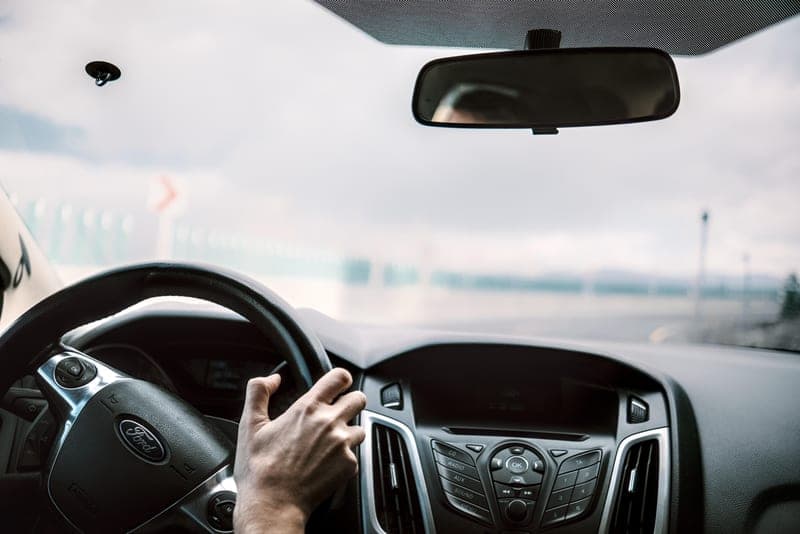
A mirror view inside a car — category photo, not this specific modelCategory photo
Our score8.7
Build9.2
Fitting8.8
Usefulness8.6
Value8.0
Check price on Amazon

#ad We may earn a commission · Amazon shows the current price

A shatterproof convex mirror that straps to the head restraint — the version of this accessory we would fit, because the glass matters.

A baby mirror is a convenience, not a safety device, and it is worth being clear about that: anything you add to a car interior becomes a projectile in a crash, which is exactly why the material and the mounting are the only specs that matter. This one uses shatterproof mirror glass rather than the cheap acrylic that cracks, and it straps to the vehicle head restraint with adjustable straps rather than balancing on a clip. It is 7.5 by 3 by 11.5 in and 1.2 lb, with a convex face that gives a head-to-toe view. Fit it tightly, check the straps every few weeks, and remember the real answer to a distressed baby is to stop the car — not to watch them in a mirror while driving.

What works

  • Shatterproof glass rather than acrylic that crazes
  • Strap mounting is far more secure than a clip
  • Convex face gives a full head-to-toe view

What to weigh

  • Only fits vehicles with an adjustable head restraint
  • Anything in the cabin is a projectile in a crash — fit it tightly
  • Costs more than generic mirrors
Published specifications for the Britax Back Seat Mirror, with the source each figure was read from
SpecPublished figureRead from
GlassShatterproof mirror glass, convexBritax product page
MountingAdjustable straps to the vehicle head restraintBritax product page
Size and weight7.5 x 3 x 11.5 in, 1.2 lbBritax product page

Verified as currently sold and checked against NHTSA's recall record on 2026-09-26; no recall named this model. Recalls apply to specific manufacture-date ranges, so check the date stamp on your own unit. Specifications come from the manufacturer or retailer listing.

Mirror or camera?

Camera systems are the other way to solve this, and they fail differently rather than better.

Mirror versus camera for watching a rear-facing child
MirrorCamera
CostLowSeveral times higher
SetupStraps to a rear headrest in a minuteMount, power, pair a screen
Night viewPoor — needs cabin lightGood, infrared
Where you lookYour existing rear-view mirror — a glance you already makeA second screen, usually lower and further from your sight line
Crash riskReal if hard-framed or loosely strappedReal — more mass, more mounting hardware, plus a cable
Fails whenThe headrest is the wrong shape or not removableThe battery dies or a connector works loose

Our position: a soft-framed mirror strapped tight to a rear headrest is the better default, because it puts the information in a place you already look. A camera earns its money for long night drives or a child with a medical reason to be monitored. Either way the object must be soft or genuinely secured, and neither is a reason to take your eyes off the road for more than a glance.

Frequently asked questions

Are baby car mirrors safe?

A soft or shatter-resistant mirror strapped tightly to a rear headrest and tug-tested is reasonable. A hard-framed mirror that is not properly secured is a projectile in a crash, and it sits at head height by design. The other risk is behavioral rather than physical: a mirror is only safe if you glance at it the way you glance at your rear-view mirror.

Do I need a car seat mirror?

No — it is a comfort purchase, not a safety device. It solves a real discomfort though: a rear-facing baby is invisible from the driver's seat, and you cannot tell whether a quiet baby is asleep or has slumped forward. If that bothers you, a mirror is a cheap fix. If it does not, the money is better spent on a car seat with better install hardware.

Is a camera better than a mirror for watching my baby?

It is better at night, because infrared works in the dark and a mirror needs cabin light. It is worse in one important way: it puts the information on a second screen away from your normal sight line, whereas a mirror uses the rear-view mirror you already check. A camera also adds more mass and mounting hardware to the cabin. For most families a good mirror is the better default.

Where should a car seat mirror be mounted?

On the rear headrest of the seat directly behind the rear-facing car seat, angled so it reflects into your rear-view mirror. Tighten the straps as far as they go and tug-test it firmly. If your vehicle's rear head restraints are fixed, oddly shaped or absent, a strap-mounted mirror is not an option in that car.

Can a mirror help with a baby who hates rear-facing?

Often, yes, because the usual objection is boredom rather than the direction of travel — being able to see a parent's face helps. It is worth checking the boring explanations first: that the recline angle and harness are comfortable, and that the child has not simply run out of legroom, which is a seat-choice problem rather than a mirror problem.

Should I buy the cheapest mirror I can find?

Not quite. The one specification that genuinely matters is frame construction, and the very cheapest mirrors are often rigid plastic with short straps, which is the combination to avoid. Beyond a soft or shatter-resistant frame and straps that properly tighten, extra money buys size and finish rather than function, so a mid-priced mirror from a known manufacturer is the sensible target.