
Skip to content
By Janet H., Owner, Janet Media GroupPublished How we research

Reviews

Bugaboo Butterfly 2 Plus review

Most travel strollers are sold on how little they weigh. This one is sold on how fast it collapses — and in an airport, with a queue behind you, that turns out to be the more useful number.

A compact folding travel stroller of the type reviewed

Buckle & Buggy earns a commission when you buy through links on this page, at no extra cost to you. It does not change what we recommend or the order we rank things in — the criteria are published on our review methodology page, and the full terms are in our affiliate disclosure.

The short version

Travel strollers are nearly always compared on weight, and weight is the wrong headline. The moment that decides whether you like a travel stroller is the thirty seconds at a gate, or at the top of a flight of subway stairs, or at the door of a cab with traffic behind it — when the stroller has to stop being a stroller immediately, with a child on one arm.

That is the specification Bugaboo built this one around. The company calls it a one-second, ultra-compact fold, and while nobody should take a marketing stopwatch literally, it is close enough to a single motion that you can do it in a boarding queue without becoming the problem. Folded it is 17.6 by 9.6 by 21.8 in, which Bugaboo publishes as IATA-compatible, and open it is 17.6 by 37.2 by 40.5 in with a 40.3 in handlebar.

The rest of the sheet is better than the travel-stroller category average. Published capacity is 50 lb and the seat is rated from birth to about 48 months, with a seat that reclines genuinely lay-flat as well as fully upright. The canopy is UPF 50+ with a peek-a-boo panel, the basket takes 17.6 lb, and Bugaboo gives four years of warranty when you buy direct from them, or two years elsewhere which can be doubled by registering the product.

The costs are real and they are all structural. At 16 lb it is noticeably heavier than the lightest cabin-size strollers. The wheels are 5.5 in at the front and 6 in at the rear, which is small, and no suspension system rescues a wheel that size on cobbles or broken slabs. Car seat use needs adapters sold separately. And it is priced at the top of the travel-stroller market, for a stroller most families use as a second one.

One point of housekeeping, because the model names in this line are confusing: Bugaboo currently sells the Butterfly 2 Plus. The original Butterfly and the Butterfly 2 appear on the brand's site now only in accessory and comparison references, so if you are reading an older review, check which generation it is about before you trust the numbers.

How we assessed it

We have not crash-tested this product and we do not own one. What we did is read the manufacturer's own specification page and manual, record every figure against the page it came from, check the model against NHTSA's recall database, and confirm it is currently sold — all on the date shown in the table below. Then we assessed it against the five criteria we apply to every product on this site.

For a travel stroller we weight fold and storage hardest, because the folded dimensions decide whether the stroller can do the job at all, and daily use second, because a travel stroller that is awkward to deploy gets left at the hotel. We read the published capacity, age range, assembled weight, folded and unfolded dimensions, basket capacity, recline description, canopy rating, front and rear wheel diameters, handlebar height, seat dimensions, car seat adapter requirement and warranty terms from Bugaboo's own product page on the date above. Bugaboo does not publish a suspension travel figure or a recline position count, so this page does not state either. The model is currently sold on bugaboo.com at a listed price, with individual colorways moving in and out of stock in the normal way.

We do not print a NHTSA star rating or an IIHS category for this model. NHTSA publishes an Ease-of-Use rating and IIHS publishes booster belt-fit ratings, but both block automated access to their databases, so we could not read a figure from the primary source. Reprinting an unverified safety number on a page a parent may rely on is not a risk worth taking, so we link the official lookup tool instead. The full method is on the methodology page.

The full assessment

01 — One-second fold

Bugaboo Butterfly 2 Plus

Bugaboo
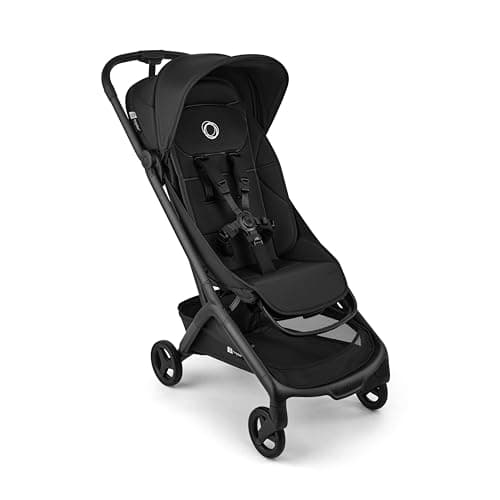
Bugaboo Butterfly 2 Plus
Our score8.4
Push and handling7.8
Fold and storage9.6
Weight8.7
Daily use8.8
Value7.0
$579.00 · View on Amazon

#ad We may earn a commission · Price as of November 10, 2026

IATA-compatible at 17.6 by 9.6 by 21.8 in folded, with a one-second fold you can do at a gate with a queue behind you.

The Butterfly 2 Plus is Bugaboo's replacement for the Butterfly 2, and it competes directly with the YOYO2 on one thing: fold speed. Bugaboo calls it a one-second fold, and it is close enough to one motion that you can do it while boarding without holding anyone up — which is exactly when a slow fold becomes a problem. Folded it is 17.6 by 9.6 by 21.8 in, which Bugaboo publishes as IATA-compatible, and it takes a child to 50 lb (22 kg), slightly more than the YOYO2. What the Plus adds over the seat it replaces is newborn provision: Bugaboo publishes it from birth to about 48 months, with a lay-flat recline, a tuck-away foot cover built into the seat and a padded headrest extension, so it does not need a bassinet to start. Against it: at 16 lb it is heavier than the YOYO2's 13.6 lb, the 5.5 in front and 6 in rear wheels struggle on cobbles like every stroller of this shape, car seat use needs separate adapters, and $579 is a lot of money for a second stroller. Between this and the YOYO2 the honest answer is close — take the Butterfly 2 Plus if fold speed and newborn use matter, the YOYO2 if you want the lighter, slimmer folded package.

What works

  • One-second fold is fast enough to do in a boarding queue
  • IATA-compatible folded size of 17.6 x 9.6 x 21.8 in
  • Published from birth with a lay-flat recline and a built-in newborn foot cover
  • 50 lb capacity, slightly more than the YOYO2

What to weigh

  • 16 lb — heavier than the lightest cabin-size strollers
  • Small wheels (5.5 in front, 6 in rear) on rough ground
  • Car seat use needs separate adapters
  • Premium price at $579
Published specifications for the Bugaboo Butterfly 2 Plus, with the source each figure was read from
SpecPublished figureRead from
Capacity50 lb (22 kg)Bugaboo product page
Folded size17.6 x 9.6 x 21.8 in, IATA-compatibleBugaboo product page
Weight16 lbBugaboo product page
RangeFrom birth to approx. 48 months, lay-flat reclineBugaboo product page
Basket17.6 lb capacityBugaboo product page
Open size17.6 x 37.2 x 40.5 inBugaboo product page
Wheels5.5 in front, 6 in rear, full suspensionBugaboo product page
CanopyUPF 50+ with a peek-a-boo panelBugaboo product page

Verified as currently sold and checked against NHTSA's recall record on 2026-10-22; no recall named this model. Recalls apply to specific manufacture-date ranges, so check the date stamp on your own unit. Specifications come from the manufacturer or retailer listing.

What IATA-compatible means, and what it does not

This is the claim that sells cabin-size strollers and it is the one most often misread, so it is worth being exact — the difference has stranded people at gates.

IATA, the airline trade body, publishes a recommended maximum cabin-bag size. A stroller described as IATA-compatible has a folded footprint inside that recommendation. The Butterfly 2 Plus folds to 17.6 by 9.6 by 21.8 in, and that is the basis of the claim.

What it is not is permission. IATA recommends; individual airlines decide, and plenty of them differ from the recommendation in both directions. Some carriers will take this stroller into the cabin without comment. Some require all strollers to be gate-checked regardless of size, especially on smaller aircraft where the overhead bins are physically shallower than the recommendation assumes. Bugaboo says as much on its own page, advising you to check with your airline, and that is the correct advice rather than a disclaimer.

The practical approach is to treat cabin carriage as a likely bonus and gate-checking as the default plan. Check your specific airline's stroller policy for your specific aircraft before you fly, and pack as though it is going into the hold — which on a stroller this size mostly means having a bag for it. We go through the policy question and the four ways of moving gear through an airport in flying with a car seat and stroller, the bin-size question specifically in strollers that fit in an overhead bin, and the screening process in car seat and stroller at the airport.

Sixteen pounds is the argument against it

If you reject this stroller it will be over this number, so here is the number in context rather than in isolation.

Bugaboo publishes 16 lb fully assembled. The lightest credible cabin-size strollers sit in the 13 to 14 lb range, which means this is carrying two to three pounds of penalty — and those are pounds you feel specifically when the stroller is folded and under your arm along with a child, a bag and a boarding pass. On a long travel day that is a genuine cost, not a rounding error.

What the extra weight buys is not nothing. The 50 lb capacity is slightly more than the lightest competitors manage, which extends the stroller's useful life at the top end. The lay-flat recline and the from-birth rating mean it can serve a newborn without a bassinet, where several lighter strollers cannot. And the frame feels like a frame rather than a folding chair, which is most of why people who own one keep it.

So the honest way to frame the trade is this. If the stroller's job is airports and holidays — folded and carried often, pushed on smooth floors — the lighter rival is the better tool and you should buy it. If the stroller's job is to be a compact everyday stroller that also travels, the extra two pounds buys range, newborn capability and build you will use every week. That is the whole decision, and we set the two out side by side in BABYZEN YOYO2 vs Bugaboo Butterfly. The third option, a slightly larger stroller with proper wheels, is argued in UPPAbaby Minu vs Bugaboo Butterfly.

The wheels, and the ground this stroller is for

Bugaboo publishes front wheels of 5.5 in and rear wheels of 6 in, with full suspension and no travel figure given. Those are small wheels, and this is the part of the product that most needs saying plainly, because it is where a travel stroller disappoints a buyer who expected otherwise.

Small wheels are a consequence of the fold, not a cost-cutting decision — a stroller cannot collapse to 9.6 in deep while carrying 8 in wheels. The physics then follow: a small wheel drops into every gap it meets rather than rolling over it, so expansion joints, cobbles, brick, gravel and the lip at the bottom of a curb cut all register as a jolt or a stop. Suspension softens the jolt; it does not change the geometry.

Where that leaves the stroller is a straightforward map of surfaces. Airport terminals, shopping centers, museums, hotel corridors, paved resort paths and smooth city sidewalks: excellent, and the fold makes it better than a bigger stroller would be. Old European cobbles, cracked residential pavement, gravel paths, grass, sand: poor, and no amount of technique fixes it. If that second list describes your daily walk, you want a stroller with larger wheels and you will have to accept a bigger fold — best city strollers is where that argument gets costed out, and best lightweight strollers is the wider category.

Two smaller specifications worth knowing while you are deciding. The seat is 11.8 by 9.4 in with 26.8 in of sitting space under the canopy, which is why the from-birth-to-48-months range is plausible rather than optimistic — a four-year-old needs head room more than seat width. And the 17.6 lb basket capacity is unusually honest for this class, where baskets are often decorative; it is enough for a day bag, which on a travel stroller is the whole requirement.

Who should buy it, and who should not

  • Anyone who folds a stroller under time pressure. Gates, cabs, turnstiles, buses, restaurant doorways. The one-second fold is the product, and it is genuinely better than the two-handed origami most compact strollers require.
  • Families who want one compact stroller to cover birth onward, since the lay-flat recline and the from-birth rating remove the need for a bassinet.
  • Frequent fliers on airlines that allow cabin strollers, where the 17.6 by 9.6 by 21.8 in fold is inside the IATA recommendation — check your own carrier first.
  • Anyone who has been disappointed by a cheap umbrella stroller and wants the same portability with a frame that does not flex. Buyers at the other end of that budget should start with best umbrella strollers.

Who should not: anyone whose binding constraint is carrying weight, because 16 lb is two to three pounds above the lightest cabin-size strollers and you will feel it on a long travel day. Anyone walking daily on cobbles, gravel or broken pavement, where 5.5 in front wheels are the wrong tool regardless of suspension. Anyone expecting to clip an infant car seat on without extra cost, since adapters are sold separately — stroller and car seat adapter compatibility covers which seats fit what. And anyone buying a single stroller to do everything on a tight budget, because this is priced at the top of the travel category and a full-size stroller gives a better everyday ride for the same money; our UPPAbaby Cruz V3 review covers that end of the trade.

For category context, best compact travel strollers ranks this against the rest of the cabin-size field, and best strollers for Disney World is the version of the question where miles of smooth pavement and a long day change the answer.

Frequently asked questions

Does the Bugaboo Butterfly 2 Plus fit in an overhead bin?

Its folded size of 17.6 x 9.6 x 21.8 in is inside the IATA cabin-bag recommendation, which is what Bugaboo's IATA-compatible description means. That is not the same as approval: individual airlines set their own stroller rules, some require every stroller to be gate-checked regardless of size, and bins on smaller aircraft are physically shallower than the recommendation assumes. Check your specific airline and aircraft before you fly, and plan for gate-checking as the default.

How much does the Bugaboo Butterfly 2 Plus weigh?

Bugaboo publishes 16 lb fully assembled. That is two to three pounds more than the lightest cabin-size strollers, and it is the clearest reason to buy something else if carrying is your main constraint. What the weight buys is a 50 lb capacity, a from-birth lay-flat recline and a frame that does not flex, so it is a trade rather than a straight loss.

Can you use the Butterfly 2 Plus from birth?

Yes. Bugaboo publishes the seat from 0 to about 48 months with a recline that goes genuinely lay-flat, so it does not need a bassinet to start — which is unusual in this class and is one of the real advantages over lighter rivals. The brand also notes a car seat adds comfort for a newborn, and car seat adapters are sold separately. For the lie-flat question in general, see our guide on bassinets versus car seats for a newborn.

What is the difference between the Bugaboo Butterfly, Butterfly 2 and Butterfly 2 Plus?

The Butterfly 2 Plus is the version Bugaboo currently sells; the earlier Butterfly and Butterfly 2 now appear on the brand's site only in accessory and comparison contexts. The Plus is the generation with the from-birth lay-flat provision and the larger wheels of the line. Because the names are so similar, check which generation any review or spec sheet is describing before you rely on its figures.

Is the Bugaboo Butterfly 2 Plus good on cobbles?

No, and no travel stroller of this shape is. Bugaboo publishes 5.5 in front and 6 in rear wheels, and a wheel that size drops into gaps rather than rolling over them, so cobbles, brick, gravel and cracked pavement all register as jolts or stops. Full suspension softens the impact without changing the geometry. The stroller is excellent on terminals, malls, museums and smooth sidewalks, and that is the honest limit of it.

Does the Butterfly 2 Plus take a car seat?

It is car seat compatible, but the adapters are sold separately and are specific to the seat you own. Budget for them as part of the purchase rather than discovering them afterward, and confirm the adapter exists for your exact infant seat model before you commit to the combination. Our guide to stroller and car seat adapter compatibility covers which seat and stroller pairings work.

What warranty does Bugaboo give on the Butterfly 2 Plus?

Four years when the stroller is bought directly from bugaboo.com. Bought elsewhere, the standard warranty is two years, which Bugaboo states can be doubled by registering the product. That is worth knowing before you choose a retailer on price alone, because the difference between a two-year and a four-year warranty on a frame-and-fold mechanism is not trivial.

Butterfly 2 Plus or the BABYZEN YOYO2?

It is close and it comes down to what the stroller is for. The Butterfly 2 Plus folds faster, takes a slightly heavier child at 50 lb and handles a newborn without a bassinet. The YOYO2 is lighter, which matters most if you carry it folded through long travel days. Buy the Butterfly if it will be a compact everyday stroller that also flies; buy the lighter one if it will mostly live in a car trunk and an airport.