Skip to content
By Janet H., Owner, Janet Media GroupPublished How we research

Travel

Car seat and stroller at the airport

Check-in, security and the gate each treat your gear differently. Knowing which is which before you arrive is the difference between a calm morning and a scramble.

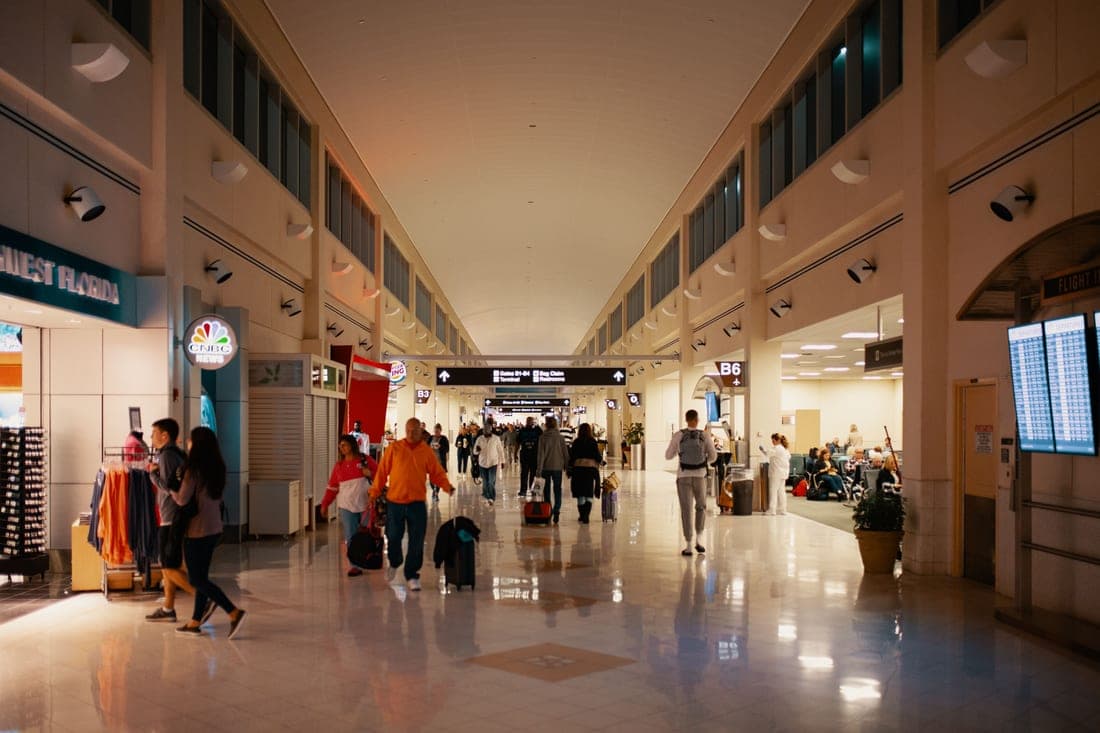
A stroller and car seat being wheeled through an airport terminal

Buckle & Buggy earns a commission when you buy through links on this page, at no extra cost to you. It does not change what we recommend or the order we rank things in — the criteria are published on our review methodology page, and the full terms are in our affiliate disclosure.

The direct answer

You can take a car seat and a stroller all the way to the aircraft door. Both go through security screening, both can be gate-checked at the jet bridge, and US airlines do not count them against your baggage allowance. The part most people get wrong is security: TSA states that strollers, umbrella strollers, baby carriers, car seats and booster seats must be screened by X-ray, and that equipment too large for the X-ray machine undergoes a visual and physical inspection instead. Your child does not stay in the stroller or seat for that — TSA's instruction is to remove infants and children from strollers and car seats and carry them through the walk-through metal detector.

The rest of this page is the sequence from curb to gate, the three places you can hand the gear over and what each one costs you, and the kit that makes the whole thing lighter. If what you actually want to know is whether to use the car seat on board, that is a different question and it is answered in car seat rules on airplanes.

Security screening, in TSA's own words

Screening is the step that catches families out, because it is the one place you have to take everything apart in front of a queue. What TSA publishes is specific and short.

  • Everything goes through the X-ray. Strollers, umbrella strollers, baby carriers, car seats, booster seats and backpacks must all be screened by X-ray.
  • Loose items can ride in the stroller. TSA says to place items in the stroller pockets or baskets, in a carry-on bag, or directly on the X-ray belt.
  • Oversized gear gets hand-inspected. Equipment that does not fit through the X-ray machine will undergo a visual or physical inspection by a TSA officer, which takes longer — budget for it if your stroller is full-size.
  • The child comes out. Remove infants and children from strollers and car seats and carry them in arms through the walk-through metal detector. An infant may be carried in a sling or carrier through the metal detector, though that may prompt additional screening.
  • Children 12 and under keep shoes, light jackets and headwear on, and modified screening procedures apply to reduce the likelihood of a pat-down.
  • Formula and breast milk over 3.4 oz are allowed, along with ice packs and gel packs. Tell the officer at the start of screening and take them out of the bag for separate screening.

The practical consequence is a choreography problem rather than a rules problem. You will need both hands free to collapse a stroller while holding a child, so fold it before you reach the belt if you can, and put the car seat on the belt first so it is the first thing out the other side.

The three places you can hand it over

A car seat and a stroller can each leave you at one of three points, and the right choice is different for each item.

Check-in, gate check or carry on — the trade in each case
Check at the counterGate checkTake on board
Your hands are freeFrom the curb onwardOnly once you reach the gateNever — it is with you
Handling it receivesFull baggage system, the roughestLoaded at the jet bridge, gentlerNone
Available at arrivalAt the carouselAt the jet bridge, usuallyImmediately
Best for the strollerOnly if you have another way through the terminalUsually the right answerOnly a cabin-size travel stroller
Best for the car seatPadded bag, accepting the riskReasonable, but it may sit on a wet rampThe safest option, and usable in flight

The general shape of a good plan: gate-check the stroller, carry the car seat on. The stroller earns its keep right up to the aircraft door — it carries the child, the bags and the coats through a terminal that is longer than you think — and it is built to be pushed around. The car seat, by contrast, is a crash-protection device whose integrity you cannot inspect after it has been through a baggage system, and if you have bought a seat for the child, it can be installed on the aircraft and used.

Gear that makes the airport easier

Three products change the airport experience more than anything else on this site. They solve different versions of the problem, so pick the one that matches your trip rather than buying all three.

01 — City trips and airports

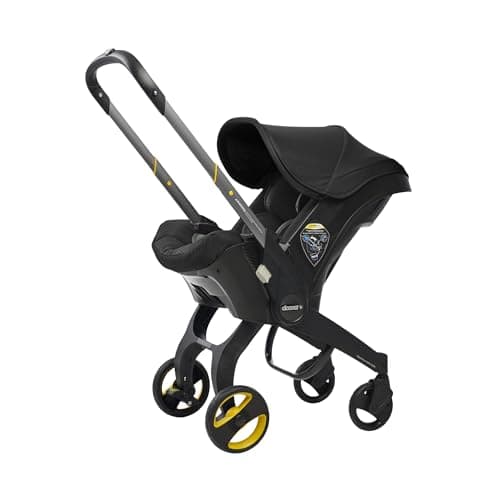
Doona+ Car Seat & Stroller

Doona
Doona+ Car Seat & Stroller
Our score8.4
Install8.4
Fit range7.6
Vehicle fit8.6
Daily use9.4
Value6.2
$550.00 · View on Amazon

#ad We may earn a commission · Price as of October 19, 2026

An infant seat whose wheels fold out of its own base, which is either the best purchase of your first year or an expensive mistake depending entirely on how you travel.

The Doona is one product doing two jobs: unfold the wheels and the car seat becomes a stroller, with no frame to lift out of a trunk. If your life is taxis, city sidewalks, airport gates and trips where a stroller frame is dead weight, nothing else does this. It is FAA approved for use on aircraft when installed baseless, which matters for the flying use case. The honest limits are the ones every Doona owner reports: it is 16.5 lb, which is heavy for a carrier you lift into a car, the storage basket is token, and the 4-35 lb / 32 in range means most babies outgrow it by height somewhere around a year — so you are buying a short-life product at a high price. It is also not a substitute for a real stroller if you do long walks. Buy it for the specific journey it solves, not as your only wheels.

What works

  • No stroller frame to carry, store or assemble
  • The best answer in this category for taxis, rideshares and airport gates
  • FAA approved for aircraft use without the base

What to weigh

  • 16.5 lb is heavy to lift in and out of a car
  • Outgrown by height at around a year, like any infant seat
  • Minimal storage, and not a real substitute for a full stroller
  • Premium price for a short-lived product
Published specifications for the Doona+ Car Seat & Stroller, with the source each figure was read from
SpecPublished figureRead from
Range4-35 lb, up to 32 inDoona product page
Weight16.5 lbDoona product page
Air travelFAA approved for aircraft use when installed baselessDoona product page

Verified as currently sold and checked against NHTSA's recall record on 2026-09-26; no recall named this model. Recalls apply to specific manufacture-date ranges, so check the date stamp on your own unit. We do not print a star rating for this seat: NHTSA publishes an Ease-of-Use rating, and we would rather send you to the source than reprint a figure we could not read first-hand. Specifications come from the manufacturer or retailer listing.
02 — Flying with a young child

Cosco Scenera NEXT

Cosco

No image
Our score8.1
Install7.8
Fit range7.0
Vehicle fit9.2
Daily use6.6
Value9.8
Check price on Amazon

#ad We may earn a commission · Amazon shows the current price

About 7 lb, cheap, and it rear-faces — which is why it is the seat most families actually take on a plane.

The Scenera NEXT is the travel seat by consensus, for two reasons that have nothing to do with refinement. It weighs about 7 lb, so you can carry it through an airport alongside everything else, and it costs little enough that you are not distraught if an airline damages it. Crucially, it rear-faces from 5-40 lb and forward-faces 22-40 lb, so unlike a forward-facing-only travel seat it works for a baby or young toddler. Do check the label for the phrase certified for use in motor vehicles and aircraft before you fly — that is the FAA requirement. As a daily seat it is poor: minimal padding, a low 40 lb ceiling in both directions and a harness that is fiddly to adjust. Buy it as a second seat for trips, not as your main one.

What works

  • About 7 lb — genuinely carryable through an airport
  • Rear-faces, so it works for babies as well as toddlers
  • Cheap enough that airline handling damage is not a disaster

What to weigh

  • 40 lb ceiling in both directions
  • Minimal padding and a fiddly harness
  • Not a seat to use every day
Published specifications for the Cosco Scenera NEXT, with the source each figure was read from
SpecPublished figureRead from
Rear-facing5-40 lbCosco consumer documentation
Forward-facing22-40 lbCosco consumer documentation
WeightAbout 7 lbCosco consumer documentation

Verified as currently sold and checked against NHTSA's recall record on 2026-09-26; no recall named this model. Recalls apply to specific manufacture-date ranges, so check the date stamp on your own unit. We do not print a star rating for this seat: NHTSA publishes an Ease-of-Use rating, and we would rather send you to the source than reprint a figure we could not read first-hand. Specifications come from the manufacturer or retailer listing.

03 — One-second fold

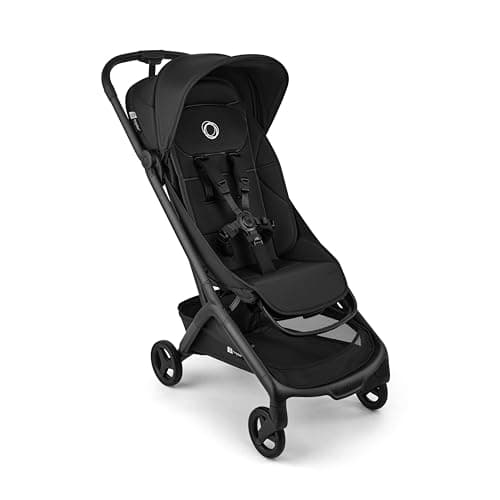
Bugaboo Butterfly 2 Plus

Bugaboo

Bugaboo Butterfly 2 Plus
Our score8.4
Push and handling7.8
Fold and storage9.6
Weight8.7
Daily use8.8
Value7.0
$579.00 · View on Amazon

#ad We may earn a commission · Price as of October 19, 2026

IATA-compatible at 17.6 by 9.6 by 21.8 in folded, with a one-second fold you can do at a gate with a queue behind you.

The Butterfly 2 Plus is Bugaboo's replacement for the Butterfly 2, and it competes directly with the YOYO2 on one thing: fold speed. Bugaboo calls it a one-second fold, and it is close enough to one motion that you can do it while boarding without holding anyone up — which is exactly when a slow fold becomes a problem. Folded it is 17.6 by 9.6 by 21.8 in, which Bugaboo publishes as IATA-compatible, and it takes a child to 50 lb (22 kg), slightly more than the YOYO2. What the Plus adds over the seat it replaces is newborn provision: Bugaboo publishes it from birth to about 48 months, with a lay-flat recline, a tuck-away foot cover built into the seat and a padded headrest extension, so it does not need a bassinet to start. Against it: at 16 lb it is heavier than the YOYO2's 13.6 lb, the 5.5 in front and 6 in rear wheels struggle on cobbles like every stroller of this shape, car seat use needs separate adapters, and $579 is a lot of money for a second stroller. Between this and the YOYO2 the honest answer is close — take the Butterfly 2 Plus if fold speed and newborn use matter, the YOYO2 if you want the lighter, slimmer folded package.

What works

  • One-second fold is fast enough to do in a boarding queue
  • IATA-compatible folded size of 17.6 x 9.6 x 21.8 in
  • Published from birth with a lay-flat recline and a built-in newborn foot cover
  • 50 lb capacity, slightly more than the YOYO2

What to weigh

  • 16 lb — heavier than the lightest cabin-size strollers
  • Small wheels (5.5 in front, 6 in rear) on rough ground
  • Car seat use needs separate adapters
  • Premium price at $579
Published specifications for the Bugaboo Butterfly 2 Plus, with the source each figure was read from
SpecPublished figureRead from
Capacity50 lb (22 kg)Bugaboo product page
Folded size17.6 x 9.6 x 21.8 in, IATA-compatibleBugaboo product page
Weight16 lbBugaboo product page
RangeFrom birth to approx. 48 months, lay-flat reclineBugaboo product page
Basket17.6 lb capacityBugaboo product page

Verified as currently sold and checked against NHTSA's recall record on 2026-10-18; no recall named this model. Recalls apply to specific manufacture-date ranges, so check the date stamp on your own unit. Specifications come from the manufacturer or retailer listing.

The Doona+ is the single-item answer: a 16.5 lb infant car seat whose wheels fold out of its own frame, FAA approved for aircraft use when installed baseless, which means one object goes through security, down the jet bridge and into the aircraft seat. It ends at 35 lb and 32 in, so it is a first-year solution rather than a travel plan for a toddler. The Cosco Scenera NEXT is the opposite approach — about 7 lb, rear-facing 5-40 lb and forward-facing 22-40 lb, light enough to carry on a shoulder strap and cheap enough that checking it is not a financial decision. The Bugaboo Butterfly 2 Plus is the stroller half, folding to 17.6 x 9.6 x 21.8 in, which Bugaboo states is IATA-compatible.

The other end of the trip

The airport is only half the problem. Whatever you do at departure, you still need a legal and correctly installed car seat between the arrivals hall and wherever you are staying, and this is where plans fall apart.

  1. 1.Rental car seats are a gamble. You get whatever is on the shelf, with an unknown history and often no manual. If you rent one, inspect it, check the expiry date and install it yourself. We cover this in rental cars and car seats.
  2. 2.Rideshare rules vary and the car seat is still your responsibility. Bringing your own is usually the only workable answer — see car seats in Ubers and Lyfts.
  3. 3.Install in daylight if you can. A first install in an unfamiliar vehicle at night after a flight is the worst possible conditions. Read your seat's baseless install page before you travel: our baseless infant car seat guide has the sequence.

Frequently asked questions

Do car seats and strollers go through airport security?

Yes. TSA states that strollers, umbrella strollers, baby carriers, car seats and booster seats must be screened by X-ray, and that equipment too large for the X-ray machine will undergo a visual or physical inspection instead. Your child is removed from the stroller or seat and carried through the walk-through metal detector.

Can I take a car seat and a stroller to the gate?

Yes. Both can go through the terminal with you and be gate-checked at the jet bridge, and US airlines do not count them against your baggage allowance. The usual best plan is to gate-check the stroller and carry the car seat onto the aircraft if you have bought a seat for the child.

Is it better to gate-check or check a car seat at the counter?

Gate-checking means less handling, because the seat is loaded at the jet bridge rather than traveling through the baggage system. Neither option lets you verify the seat's integrity afterwards. If the car seat matters to you, carry it on and use it in the aircraft seat; if it must be checked, use a padded bag.

Can I bring formula and breast milk through security?

Yes, in quantities over 3.4 oz, along with ice packs, freezer packs and gel packs. TSA asks you to tell the officer at the start of screening and to remove these items from your carry-on for separate screening. Your child does not need to be traveling with you to bring breast milk.

Does my child have to come out of the stroller at security?

Yes. TSA's instruction is to remove infants and children from strollers and car seats and carry them in arms through the walk-through metal detector. An infant may be carried in a sling or carrier, though that can trigger additional screening. Children 12 and under keep their shoes, light jackets and headwear on.

What is the easiest car seat and stroller setup for an airport?

For a baby under 35 lb, the Doona+ — it is a car seat and a stroller in one object, FAA approved for aircraft use when installed baseless. For an older child, a light travel car seat such as the Cosco Scenera NEXT at about 7 lb paired with a cabin-size stroller is the usual combination.