Skip to content
By Janet H., Owner, Janet Media GroupPublished How we research

Reviews

Chicco KidFit ClearTex Plus review

Comfort is a safety feature on a booster, because a comfortable child sits properly. This is the booster that takes that seriously, and the entry height that may rule it out.

A school-age child sitting on a booster seat with the vehicle belt across the shoulder

Buckle & Buggy earns a commission when you buy through links on this page, at no extra cost to you. It does not change what we recommend or the order we rank things in — the criteria are published on our review methodology page, and the full terms are in our affiliate disclosure.

The short version

A booster does not restrain a child. It raises and positions them so the vehicle's own lap-and-shoulder belt crosses the middle of the shoulder and sits low across the hips, and then the belt does the work. Every booster legally sold in the US meets the same federal standard, so the differences between them are not differences in crash performance — they are differences in belt geometry, adjustment range, and whether a child will sit in the thing properly for an hour.

That last point is why this booster is worth a page. The KidFit ClearTex Plus is the comfort option in a category where comfort is usually dismissed as a luxury, and on a booster it is not: a child who is uncomfortable slouches, tucks the shoulder belt behind their arm, or leans out of position, and all three defeat the only thing the booster was bought to do. Chicco pairs that padding with ten headrest positions, two recline positions, double-layer side protection around the head, and a one-pull LATCH tightener with quick-release connectors.

The two things to check before you buy are both in Chicco's published range. The entry height is 44 in and the minimum age is four years, which is higher than some boosters and will rule this out for a small four-year-old. And it is bulkier than a basic booster, which makes it harder to fit alongside other seats. Everything in this review was read from Chicco's own product page on 5 November 2026.

How we assessed it

We have not crash-tested this product and we do not own one. What we did is read the manufacturer's own specification page and manual, record every figure against the page it came from, check the model against NHTSA's recall database, and confirm it is currently sold — all on the date shown in the table below. Then we assessed it against the five criteria we apply to every product on this site.

Boosters are the most honestly assessable category on this site, because the function is singular: does it put the belt in the right place, and does it keep doing so as the child grows. So we recorded the published highback and backless ranges separately, the entry height and minimum age, the number of headrest and recline positions, what the LATCH attachment actually does, and the fabric and emissions certifications. We also checked the KidFit specifically against NHTSA's 2025 recall of a different Chicco harness-and-booster, because the two products are easy to confuse by name.

We do not print a NHTSA star rating or an IIHS category for this model. NHTSA publishes an Ease-of-Use rating and IIHS publishes booster belt-fit ratings, but both block automated access to their databases, so we could not read a figure from the primary source. Reprinting an unverified safety number on a page a parent may rely on is not a risk worth taking, so we link the official lookup tool instead. The full method is on the methodology page.

The full assessment

01 — Comfort on long drives

Chicco KidFit ClearTex Plus

Chicco
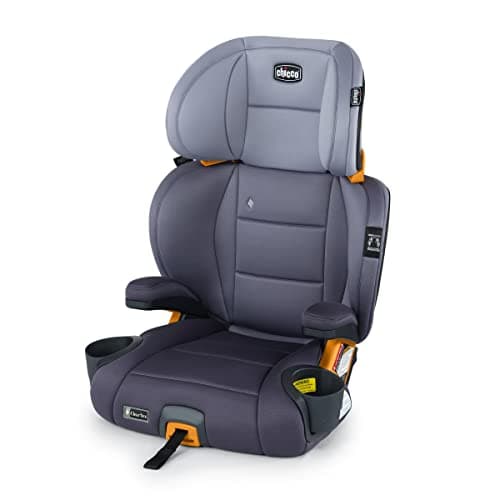
Chicco KidFit ClearTex Plus
Our score8.9
Belt fit9.0
Install9.2
Fit range8.6
Daily use9.4
Value8.0
$109.99 · View on Amazon

#ad We may earn a commission · Price as of November 10, 2026

The booster a child will not complain about on a four-hour drive, with double-layer head protection and a quick-release LATCH that stops it flying around empty.

Booster comfort is a safety feature in disguise: a child who is comfortable stays seated properly, and a child who is not slouches, tucks the shoulder belt behind their arm, or argues about the whole thing. The KidFit ClearTex Plus has the best padding in this group, plus DuoGuard double-layer side protection around the head. The range is 40-100 lb in highback mode and 40-110 lb backless, for children at least four years old and 44-57 in. The quick-release LATCH is worth more than it sounds — it holds the empty booster to the seat so it is not loose in the cabin, while still detaching in a second. Costs more than the Graco, and 44 in is a higher entry height than some, so check your child clears it.

What works

  • Best padding here — children genuinely object less on long drives
  • DuoGuard double-layer head protection
  • Quick-release LATCH keeps the empty booster secured

What to weigh

  • Costs noticeably more than the Graco
  • 44 in minimum height is higher than some boosters
  • Bulkier, so three across is harder
Published specifications for the Chicco KidFit ClearTex Plus, with the source each figure was read from
SpecPublished figureRead from
Highback range40-100 lbChicco product page
Backless range40-110 lbChicco product page
Height and age44-57 in, age 4+Chicco product page
Side protectionDuoGuard — two layers around the headChicco product page
AttachmentSuperCinch tightener with quick-release LATCHChicco product page
FabricClearTex — no added flame retardantsChicco product page

Verified as currently sold and checked against NHTSA's recall record on 2026-11-05; no recall named this model. Recalls apply to specific manufacture-date ranges, so check the date stamp on your own unit. We do not print a star rating for this seat: NHTSA publishes an Ease-of-Use rating and IIHS publishes booster belt-fit ratings, and we would rather send you to the source than reprint a figure we could not read first-hand. Specifications come from the manufacturer or retailer listing.

The 44-inch entry height is the first thing to check

Chicco publishes 44-57 in and at least four years old for this booster, in both modes, with 40-100 lb in highback and 40-110 lb backless. The height floor is the figure that catches people out, because weight is usually the number families watch and a child frequently reaches 40 lb before 44 in.

Treat the height floor as a hard gate rather than a guideline. It exists because the belt guides are positioned for a torso of a certain length, and a child shorter than the floor will not get the belt geometry the seat was designed to produce. If your child is 40 lb and 42 in, they are not ready for this booster — and in most cases they are not ready for any booster, which is a different and more important conversation. We set out the actual readiness test in car seat vs booster seat, and the honest answer for most children that age is to stay in a harness.

At the other end, 57 in and 110 lb is a reasonable but not exceptional ceiling. Plenty of children still need a booster past 57 in, because the marker for stopping is whether the adult belt fits — usually around 4 ft 9 in and often ages 10 to 12. If you have a tall eight-year-old, check when can a child stop using a booster seat before assuming this will be the last booster you buy.

Quick-release LATCH on a booster, and why it matters

Chicco fits this booster with a SuperCinch one-pull tightener and quick-release LATCH connectors. It is easy to dismiss LATCH on a booster, because the child is held by the vehicle belt and the booster itself is not restraining anyone. The reason it matters is what happens when nobody is sitting on it.

An unoccupied booster that is not attached to anything is a loose object in the cabin. In a crash or a hard stop it becomes a projectile, and in ordinary use it slides out of position every time the car corners, which is how a booster ends up half off the bench when a child climbs in. Anchoring it fixes both. The quick-release half of the feature is what makes anchoring realistic: a booster that takes two minutes to detach will be left unanchored by anyone who moves it between cars.

  • Use the lower anchors when the position has them. The booster stays put between journeys and cannot become a projectile when empty.
  • Do not use lower anchors as a substitute for the vehicle belt over the child. The belt is what protects the child. The anchors only secure the booster.
  • Check your vehicle manual for anchor positions. Center positions often have none, and borrowing anchors from the two outboard positions is prohibited in most vehicles.

The rest of the daily-use picture is ordinary and well executed: ten headrest positions to track growth without rethreading anything, two recline positions, two fold-in cup holders Chicco lists as dishwasher safe, and covers — armrests included — that come off and go in the machine on a cold delicate cycle. On a product that will spend years absorbing spills, removable covers are worth more than they sound.

ClearTex, and what flame-retardant-free does and does not mean

Chicco's ClearTex line is fabric made without added flame retardant chemicals, and this booster is GREENGUARD Gold certified for low chemical emissions. Chicco also states the seat meets FMVSS 213b frontal impact requirements. Those are three separate claims and they are worth separating, because the marketing around fabric chemistry invites people to read them as one thing.

What each claim covers
ClaimWhat it actually says
ClearTexNo flame retardant chemicals were added to the fabric. It is a materials claim about what is not in the cover.
GREENGUARD GoldA third-party certification for low chemical emissions, tested against the certifier's thresholds. It is about what the product gives off, not about crash performance.
FMVSS 213bThe federal child restraint standard, including the updated frontal impact requirements. This is the crash-performance claim, and every booster sold in the US has to meet the applicable standard.

Flame-retardant-free fabric is a legitimate reason to pay more if the chemistry matters to you, and Chicco offers it across a whole line rather than on one premium trim. What it is not is a safety upgrade in the crash sense — a booster with treated fabric is not less protective. Decide on it as a materials preference and price it accordingly. We cover how the published safety numbers on car seats are actually generated in car seat safety ratings explained.

The 2025 Chicco recall was a different seat

If you search for a Chicco booster recall you will find one, and it is worth being precise about what it covers, because the names are close enough to confuse. NHTSA campaign 25C005 covers the Chicco MyFit Zip Air harness-and-booster — model numbers 07079561970070 and 04079561190070, manufactured between September 2020 and August 2024, around 30,984 units. The finding was that in certain configurations the seat could allow excessive chest movement in a crash and so failed to comply with FMVSS 213. Chicco's remedy was a free kit mailed to owners, with owner notification letters sent in July 2025.

That is a harnessed combination seat, not this belt-positioning booster, and we found no recall covering the KidFit ClearTex Plus when we checked on 5 November 2026. Two practical points follow. If you own a MyFit Zip Air in that date range, check your model number and get the kit. And in general, treat brand-level recall news as a prompt to look up your own model number and manufacture date, never as an answer — how to check a car seat recall sets out the lookup.

Test the fit on your own child

No booster review can tell you whether a booster fits your child in your car, because belt geometry differs between vehicles and children are different shapes. Run this after buying, and again every few months:

  1. 1.Can the child sit all the way back against the booster, with knees bending comfortably at the front edge of the cushion?
  2. 2.Does the lap belt sit low across the hips and upper thighs, on bone, rather than riding up onto the stomach?
  3. 3.Does the shoulder belt cross the middle of the shoulder and the center of the chest — not the neck, not sliding off the arm?
  4. 4.Can the child stay seated properly for the whole trip, without slouching, leaning out or tucking the shoulder belt behind them?
  5. 5.Are their feet supported enough that they are not tempted to fidget out of position?

If any one fails with the booster, adjust the headrest height or reconsider the product. If all five pass without it, your child no longer needs a booster at all.

Who should buy it

  • Children who ride for long stretches. This is the case the padding genuinely earns, because a comfortable child keeps the belt where it belongs.
  • Anyone who wants a booster that stays put. Quick-release LATCH is the difference between a booster that is anchored and one that is theoretically anchorable.
  • Buyers who care about fabric chemistry. ClearTex plus GREENGUARD Gold is a documented pair of claims, not a vague one.
  • Families who want one booster to cover highback now and backless later, with 40-100 lb and 40-110 lb published for the two modes.

Who should not: a child under 44 in or under four, who is not eligible, and probably is not ready either; anyone fitting three seats across a bench, where the bulk counts against it and a slimmer booster wins; anyone buying a second or third booster for another car or for grandparents, where the value case favors the cheaper option in our Graco TurboBooster 2.0 review; and anyone whose booster will live in a bag, who should look at travel boosters.

One thing no booster can do, this one included: fly. Booster-type seats are specifically excluded from use on an aircraft, even when the seat carries the red aircraft certification marking — the FAA-approved car seat label explains why the marking and the mode are two different things.

Frequently asked questions

Is the Chicco KidFit ClearTex Plus worth the extra money over a basic booster?

It depends on how your child rides. You are paying for padding, ten headrest positions, double-layer head protection, quick-release LATCH and flame-retardant-free fabric. None of that buys better crash performance than a cheap booster that produces a correct belt fit. What it buys is a child who is more likely to sit properly for an hour, which is the thing that actually decides whether the belt protects them. For long daily journeys that is a real case; for a spare booster in a second car it is not.

What are the height and weight limits on the Chicco KidFit ClearTex Plus?

Chicco publishes 44-57 in and at least four years old, with 40-100 lb in highback mode and 40-110 lb backless. The 44 in minimum is the figure to check first, because children often reach 40 lb well before 44 in. Meeting the minimum makes a child eligible, not ready — they also need to have genuinely outgrown their harnessed seat and be able to sit properly for a whole trip.

Should I use it in highback or backless mode?

Highback while the child is younger, or when the vehicle seat back is low or has no head restraint — the highback carries its own shoulder-belt guide, adds side structure around the head, and gives a sleeping child something to lean against. Backless once the child is tall enough that the vehicle's own head restraint supports their head, which also makes the booster far easier to move between cars.

Does the Chicco KidFit ClearTex Plus attach to the car?

Yes. It has a SuperCinch one-pull tightener with quick-release LATCH connectors. Use them where the seating position has lower anchors. The point is not the child's protection, which comes from the vehicle belt over them, but that an unoccupied anchored booster cannot become a projectile and does not slide out of position between journeys.

Has the Chicco KidFit been recalled?

We found no recall covering the KidFit ClearTex Plus when we checked on 5 November 2026. There is a 2025 Chicco recall, NHTSA campaign 25C005, but it covers the MyFit Zip Air harness-and-booster — a different product — for seats made between September 2020 and August 2024, over excessive chest movement in certain configurations. Check your own model number and manufacture date against NHTSA's database rather than relying on brand-level news.

What does ClearTex actually mean?

It is Chicco's name for fabric made without added flame retardant chemicals. This booster is also GREENGUARD Gold certified, which is a third-party certification for low chemical emissions. Neither claim is about crash performance — that is covered by the federal standard, FMVSS 213b, which every booster sold in the US has to meet. Treat flame-retardant-free fabric as a materials preference worth paying for if it matters to you, not as a safety upgrade.