Skip to content
By Janet H., Owner, Janet Media GroupPublished How we research

Reviews

Evenflo Revolve360 Extend review

Rotating seats usually ask you to give up extended rear-facing. This one does not, and that single fact is most of the reason to consider it.

A rotating convertible car seat of the type reviewed, installed in a vehicle

Buckle & Buggy earns a commission when you buy through links on this page, at no extra cost to you. It does not change what we recommend or the order we rank things in — the criteria are published on our review methodology page, and the full terms are in our affiliate disclosure.

The short version

Rotating car seats exist to solve one specific, genuinely miserable problem: loading a rear-facing child into a tight back seat means leaning in, twisting, and lifting a thirty-pound toddler at an angle no physiotherapist would endorse. Doing that twice a day for two years is how a lot of families end up turning the seat forward before they should.

A seat that swivels to face the open door removes the twist entirely. The catch across the category has been that most rotating seats stop rear-facing at 40 lb — so the seat that was supposed to make rear-facing easier quietly shortens how long you can do it. That is a bad trade and it is the trade the Revolve360 Extend does not ask you to make.

Evenflo publishes rear-facing 4-50 lb and 17-48 in, forward-facing 30-65 lb and 35-49 in, and a high-back booster mode at 40-120 lb and 44-57 in. The 50 lb rear-facing figure is the headline: it matches dedicated extended-rear-facing convertibles rather than the rotating seats it competes with. What you pay for that is bulk — 32.4 lb of seat, deep front to back — and a price above a conventional convertible with the same numbers.

The other thing you should know before buying is the recall picture, which is more nuanced than either "it's recalled" or "it's fine." That is the section below, and it is the reason this review exists in the form it does.

How we assessed it

We have not crash-tested this product and we do not own one. What we did is read the manufacturer's own specification page and manual, record every figure against the page it came from, check the model against NHTSA's recall database, and confirm it is currently sold — all on the date shown in the table below. Then we assessed it against the five criteria we apply to every product on this site.

Rotating seats add a mechanism, and a mechanism is a thing that can be installed wrong, so we weighted installation and vehicle fit more heavily here than on a conventional convertible. We read the published limits for all three modes from Evenflo's own product page, recorded the installation system it uses, checked the model name and model numbers against NHTSA's current recall records for Evenflo child restraints, and confirmed the seat is currently purchasable. The one figure we deliberately do not estimate is front-to-back depth in a specific vehicle: rotating seats are deep, depth interacts with your front seats, and the only reliable answer is a trial install in your own car.

We do not print a NHTSA star rating or an IIHS category for this model. NHTSA publishes an Ease-of-Use rating and IIHS publishes booster belt-fit ratings, but both block automated access to their databases, so we could not read a figure from the primary source. Reprinting an unverified safety number on a page a parent may rely on is not a risk worth taking, so we link the official lookup tool instead. The full method is on the methodology page.

The full assessment

01 — Rotating with 50 lb rear-facing

Evenflo Revolve360 Extend

Evenflo
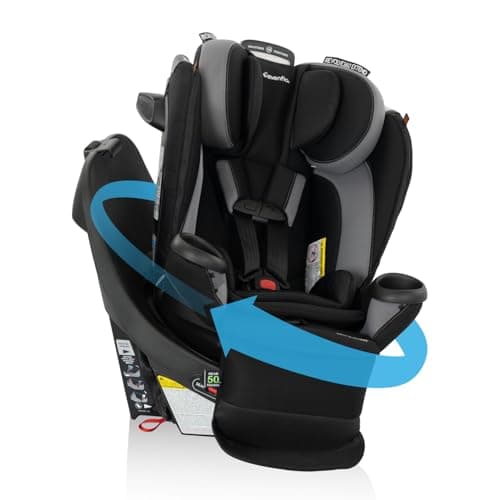
Evenflo Revolve360 Extend
Our score8.8
Install8.6
Fit range9.4
Vehicle fit7.2
Daily use9.6
Value7.8
$439.99 · View on Amazon

#ad We may earn a commission · Price as of October 19, 2026

The only rotating seat here that rear-faces to 50 lb, so you do not have to trade extended rear-facing for a seat that swivels.

Rotating seats solve a real problem — loading a child rear-facing into a tight back seat is awkward, and a seat that turns to the door removes the twisting and lifting that makes parents give up and turn the seat forward early. The catch across the category is that most rotating seats stop rear-facing at 40 lb. The Revolve360 Extend goes to 50 lb (17-48 in), then forward-faces 30-65 lb (35-49 in), then runs a high-back booster at 40-120 lb (44-57 in). So it is the rotating seat that does not force the compromise. It is heavy at 32.4 lb, it is deep front to back, and it costs more than a conventional convertible with the same limits. On the recall question: NHTSA recall 26C004 (July 2026, headrest may shift position) covers REO by Revolve360 models CS260212521, CS260212522, CS260212536, CS260212537, CS260212538 and CS260212539 — not this model. Recalls are scoped by model number and manufacture date, so check the label on your own unit before you install it.

What works

  • 50 lb rear-facing — the longest of the rotating seats here
  • Rotation makes loading a rear-facing child genuinely easier
  • Carries on to a forward-facing harness and a 120 lb booster mode

What to weigh

  • 32.4 lb and deep front to back — trial-fit it before committing
  • Costs more than a conventional seat with the same limits
  • Evenflo has recalled other models in this range in the past year — check your unit's model number and date
Published specifications for the Evenflo Revolve360 Extend, with the source each figure was read from
SpecPublished figureRead from
Rear-facing4-50 lb, 17-48 inEvenflo product page
Forward-facing30-65 lb, 35-49 inEvenflo product page
High-back booster40-120 lb, 44-57 inEvenflo product page
Rotation360 degrees to the door, one-handEvenflo product page
Seat weight32.4 lbEvenflo product page
InstallSure360 system — LockStrong belt tensioning, Tether360Evenflo product page
MaterialsGREENGUARD Gold certified; polyester and polyurethane fabricEvenflo product page

Verified as currently sold and checked against NHTSA's recall record on 2026-10-08; no recall named this model. Recalls apply to specific manufacture-date ranges, so check the date stamp on your own unit. We do not print a star rating for this seat: NHTSA publishes an Ease-of-Use rating, and we would rather send you to the source than reprint a figure we could not read first-hand. Specifications come from the manufacturer or retailer listing.

The recall question, precisely

In July 2026 Evenflo recalled roughly 59,661 child restraints under NHTSA recall number 26C004, because the headrest could shift from a higher position to a lower one under certain crash conditions. That is a serious defect and it is in the Revolve360 family, so it deserves a straight answer rather than a reassuring sentence.

The straight answer: the recall names the REO by Revolve360, not the Revolve360 Extend. The affected units are listed by colorway and model number — Nantucket CS260212537, Danvers CS260212538, Chelsea CS260212539, Holden CS260212536, Brookline CS260212521 and Lenox CS260212522. The Extend is a different model in the same product line and is not named in that recall.

It is also fair to note the pattern rather than only the individual event. Evenflo has issued more than one child restraint recall in the past year across different models in its range, which is a reasonable thing to weigh when you are choosing between brands. It is not, on its own, a reason to rule the brand out: every seat sold in the US meets the same federal standard, recalls are how a defect gets fixed rather than evidence that nothing was being watched, and a manufacturer that recalls promptly is behaving correctly. But if a clean recent record is something you want to buy, that is a legitimate preference and you should check each shortlisted brand against the database rather than against its advertising.

If a recall does apply to your unit, do not throw the seat away and do not keep using it outside whatever interim guidance the manufacturer gives. Register the seat, follow the remedy instructions, and in the meantime read our guidance on secondhand car seat safety, which covers how to establish a seat's history and why an unknown history is itself a reason to decline a seat.

What rotation actually buys you

The honest case for a rotating seat is ergonomic rather than protective. A swiveling seat is not safer than a fixed one in a crash — both meet the same federal standard, and the seat is locked in its travel position when the car is moving. What rotation changes is the ten seconds either side of every journey, and that turns out to matter more than it sounds:

  • It removes the twist-and-lift. You turn the seat to the door, sit the child in facing you, buckle them at a normal working height, and turn the seat back. Your spine stays neutral throughout.
  • It makes harnessing accurate. A harness you can see and reach is a harness you tighten properly. A harness you are fumbling at blind, from a crouch, with your head against the door frame, is the one that ends up two fingers loose.
  • It extends how long rear-facing stays tolerable. This is the real safety argument, and it is indirect: the families who turn a seat forward early overwhelmingly do it because rear-facing became physically unpleasant for the adult, not because they decided forward-facing was better.
  • It helps most in exactly the cars where it is hardest to fit. Two-door cars, low rooflines and tight rear footwells are where rotation pays off and also where a deep seat may not go in. That tension is the main reason to trial-fit.

The counter-case is equally honest. Rotation adds weight, depth and cost, and it adds a moving interface between the base and the shell. If your back seat is roomy, your child is still small, and your back is fine, a conventional convertible with the same 50 lb rear-facing limit will cost less and take up less room. The whole category is laid out on best rotating car seats, and the non-rotating alternatives with comparable rear-facing range are on best convertible car seats.

Installation and the features that carry it

Evenflo installs this seat with what it calls the Sure360 Safety Installation System, which combines a LockStrong belt-tensioning mechanism with Tether360 tethering. In plain terms: the base is designed to be cinched tight with a lever rather than by kneeling on the seat and hauling on a strap, and the tether routing is built to work in both orientations rather than only forward-facing.

That matters because a rotating seat has to be installed correctly once and then left alone. On a conventional seat, a mediocre install announces itself — the seat moves when you nudge it. On a rotating seat, the shell is supposed to move, which makes it easier to mistake a loose base for a working swivel. Install it, then test the base rather than the shell: grip the base at the belt path and push side to side and front to back. Under an inch of movement at the belt path is the standard, and it applies here exactly as it does everywhere else.

Two other practical notes. First, a seat this deep interacts with your front seats, so install it before you decide it fits and check that the driver can still sit in a legal driving position. Second, the lower-anchor weight ceiling applies to this seat as it does to every seat: past the limit in the manual you switch to a seat belt install plus the top tether. Our how to install a car seat guide covers both methods, and the installation checklist is the printable version.

On materials, Evenflo publishes GREENGUARD Gold certification for this seat and lists the fabric as polyester and polyurethane. GREENGUARD Gold is a chemical-emissions certification, which is a different and narrower claim than "no added flame retardants" — worth knowing if fabric chemistry is one of your criteria, because the two are often spoken about as though they are the same thing.

Who should buy it

  • Anyone who wants to rear-face past 40 lb and also wants a seat that swivels. This is the pick that does not make you choose, and if that describes you the decision is close to made.
  • Parents with a back problem, a tight back seat, or both. The ergonomics are the product. If loading the child is the part of your day you dread, this fixes it.
  • Families buying one seat for a long run. Three modes to a 120 lb booster is a genuinely long service life, as long as you have somewhere to put a seat this size.

Who should not: anyone with a small car or a three-across problem, because 32.4 lb and a deep shell is the wrong shape for both — start at best car seats for small cars instead. Anyone who moves a seat between cars regularly, since this is not a seat you carry cheerfully. Anyone shopping on price, because a conventional convertible delivers the same rear-facing ceiling for meaningfully less. And anyone who wants a brand with no recent recalls in its range, which is a legitimate filter that this one does not pass.

The seat this one is most often shortlisted against is the Chicco Fit360 ClearTex, and the two are compared specification by specification in Evenflo Revolve360 Extend vs Chicco Fit360.

Frequently asked questions

Is the Evenflo Revolve360 Extend recalled?

Not by name. NHTSA recall 26C004, issued in July 2026 over a headrest that could shift position in a crash, covers REO by Revolve360 seats — model numbers CS260212521, CS260212522, CS260212536, CS260212537, CS260212538 and CS260212539. The Revolve360 Extend is a different model in the same line and is not listed. Because recalls are scoped by model number and manufacture date rather than by product family, the only answer that applies to your seat is the one you get by looking up the label on the shell in NHTSA's database.

How long can a child rear-face in the Revolve360 Extend?

Evenflo publishes a rear-facing range of 4-50 lb and 17-48 in. The 50 lb ceiling will carry most children to somewhere around four years old and some beyond it, which is longer than the 40 lb limit common to rotating seats and matches dedicated extended-rear-facing convertibles. In practice the 48 in height limit or the shell height at the child's head will often end rear-facing before the weight does.

Are rotating car seats safe?

Yes. Every child restraint sold in the US meets the same federal crash standard, and a rotating seat is locked in its travel orientation while the vehicle is moving. What rotation does not do is make a child safer in a crash than a correctly installed fixed seat. Its real safety contribution is indirect and genuine: by making it physically easy to load a rear-facing child, it removes the main practical reason families turn a seat forward too early.

How much does the Revolve360 Extend weigh and will it fit my car?

Evenflo publishes a seat weight of 32.4 lb, which is heavy for a convertible, and rotating seats are deep front to back because the shell has to clear the base as it turns. Depth is what decides whether it fits, and depth interacts with how far forward your front seats have to be. Install it in your own car before deciding, and confirm the driver can still reach the pedals in a proper driving position.

Does it work as a booster seat afterwards?

Evenflo publishes a high-back booster mode at 40-120 lb and 44-57 in, so yes. The usual caveat for any three-mode seat applies: a shell designed to rear-face a newborn is bulkier as a booster than a dedicated booster is, and belt fit is typically less precise. If the child is the last in the family to need a seat, running this to the end is reasonable. If a dedicated booster would serve better by then, our best booster seats list covers that.

Is it worth paying more for a rotating seat?

It depends on how hard loading the child currently is. A conventional convertible with the same 50 lb rear-facing ceiling costs less, weighs less and takes less room, and for a roomy back seat and a parent with no back trouble that is the better value. If you have a tight rear footwell, a two-door car, a bad back, or you are already feeling the pull to turn the seat forward early, rotation buys you something real every single day. That is the case for the premium.

What is GREENGUARD Gold certification, and is it the same as flame-retardant-free?

No, and the two get conflated constantly. GREENGUARD Gold certifies low chemical emissions from the finished product. "No added flame retardants" is a separate claim about what was put into the fabric, which some manufacturers make explicitly under their own branding. Evenflo publishes GREENGUARD Gold for this seat and lists the fabric as polyester and polyurethane. If flame-retardant chemistry specifically is one of your criteria, look for a manufacturer that states that claim directly rather than treating an emissions certification as a proxy for it.