
Skip to content
By Janet H., Owner, Janet Media GroupPublished How we research

Car Seats

The best car seats for 5-year-olds

At five, the box says booster and your child might not be ready for one. Maturity decides this, not the weight label — and the seat you buy should follow whichever answer is true.

A five-year-old child buckled into a forward-facing car seat

Buckle & Buggy earns a commission when you buy through links on this page, at no extra cost to you. It does not change what we recommend or the order we rank things in — the criteria are published on our review methodology page, and the full terms are in our affiliate disclosure.

Our picks at a glance

Five is the age at which car seat shopping stops being about the child's body and starts being about their behavior. Almost every five-year-old in the US clears the weight and height minimums printed on a booster seat. That is not the same as being ready for one, and the gap between those two facts is where this whole decision lives.

A harnessed seat restrains a child whether or not they cooperate. A booster does not restrain anyone — it raises and positions the child so the vehicle's own lap-and-shoulder belt crosses the middle of the shoulder and sits low across the hips, and then the belt does the work. That handover only functions if the child stays upright, leaves the belt alone, and holds that position for the entire journey, including the part where they fall asleep twenty minutes from home.

So there are really two correct answers for a five-year-old, and which one applies to you depends on a question no spec sheet can answer. Our list covers both: three seats that keep a five-year-old in a five-point harness, and two boosters for the child who is genuinely ready to graduate.

Our ranking — The best car seats for 5-year-olds
#ProductBest forOur scorePrice
1
Chicco MyFit Air ClearTex

Chicco MyFit Air ClearTex

A forward-facing harness that becomes a booster, for the child who is heavy enough for a booster but not yet mature enough to sit in one properly.

Not ready for a booster yet8.6out of 10
$227.99 · Amazon

#ad commission · as of October 19, 2026

2
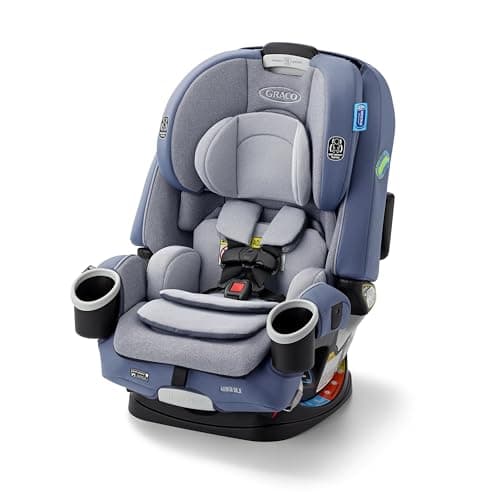
Graco 4Ever DLX 4-in-1

Graco 4Ever DLX 4-in-1

Four stages and ten years of use from 4 lb to 120 lb, at a price that makes buying three separate seats hard to justify.

One seat, ten years8.8out of 10
$319.99 · Amazon

#ad commission · as of October 19, 2026

3
No image

Diono Radian 3QXT

17 in wide, steel-framed, rear-faces to 50 lb and carries on to a 120 lb booster — the standard answer when three seats have to fit in one row.

Three across8.6out of 10
4
No image

Britax Highpoint

Goes to 120 lb and 63 in, which is the booster to buy if your child will still need one after most boosters have run out.

Tall and older children8.9out of 10
5
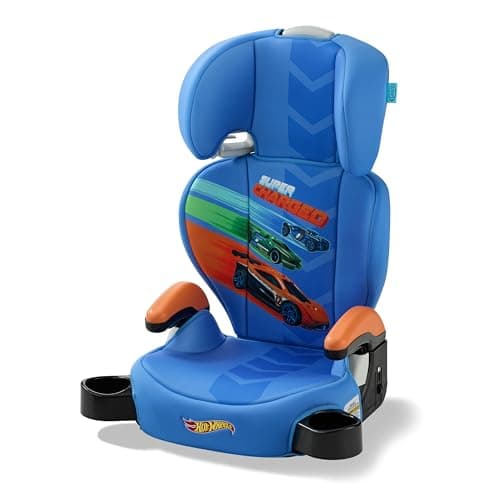
Graco TurboBooster 2.0

Graco TurboBooster 2.0

The default booster: highback to start, backless later, open belt guides that position the belt where it needs to be, and a price that makes a second one for the other car easy.

Most families9.0out of 10
$79.99 · Amazon

#ad commission · as of October 19, 2026

Rows link to the full assessment further down this page. Scores are our own editorial ratings against the criteria on our methodology page — they are not crash-test results and not a NHTSA or IIHS rating.

How we chose

We ranked these on the two things that decide whether a five-year-old is protected: how far the harness ceiling extends, for families who need more harnessed years, and how reliably the seat produces a correct belt fit, for families moving to a booster. Everything else — cup holders, fabric, recline positions — is comfort, and comfort only matters here insofar as a comfortable child sits still.

  • Forward-facing harness ceiling. A 65 lb harness limit buys roughly two more years than a 40 lb one. For a five-year-old who cannot yet be trusted in a belt, that headroom is the entire product.
  • Whether the seat converts. A harness-to-booster seat makes the switch happen when the child is ready rather than when the seat runs out, which removes the pressure to graduate early.
  • Belt guide quality, for the booster picks — a shoulder guide that holds the belt at mid-shoulder and lap horns that keep the lap belt on the hips.
  • Height ceiling, not just weight. Most five-year-olds outgrow a seat by standing height or by seated shoulder height before they outgrow it by weight. We read both figures.
  • Vehicle fit. Width matters at five, because by then there is often a sibling seat beside it and a third passenger in the row.
  • Published range read from the manufacturer's own page, with the recall database checked against each model.

We have not crash-tested any of these seats — no consumer publication in the US does, and every seat here has already passed the same federal standard. What we did was read each manufacturer's specification page and manual, record every figure against the page it came from, check each model against NHTSA's recall database, and confirm it is currently sold. The dates of those checks are printed on every product below. Our full method is on the methodology page.

The picks in detail

01 — Not ready for a booster yet

Chicco MyFit Air ClearTex

Chicco
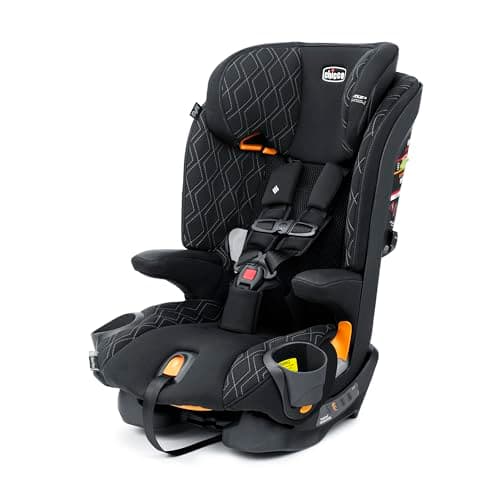
Chicco MyFit Air ClearTex
Our score8.6
Belt fit8.6
Install9.0
Fit range8.8
Daily use8.4
Value8.2
$227.99 · View on Amazon

#ad We may earn a commission · Price as of October 19, 2026

A forward-facing harness that becomes a booster, for the child who is heavy enough for a booster but not yet mature enough to sit in one properly.

Weight is not the only thing that decides booster readiness — a booster only works if the child sits upright and leaves the belt alone for the whole journey, and plenty of four- and five-year-olds who meet the weight limit cannot do that yet. A harness-to-booster keeps them in a five-point harness until they can. The MyFit runs a forward-facing harness from 26.5-65 lb and then a belt-positioning booster from 40-100 lb, so the switch happens when the child is ready rather than when the seat runs out. It is bulky and it does not rear-face at all, so it is a second or third seat rather than a first. If you are staring at a booster wondering whether your child will actually stay put in it, buy this instead.

What works

  • Keeps a not-quite-ready child in a harness past the booster weight limit
  • 65 lb harness limit is high
  • ClearTex fabric

What to weigh

  • No rear-facing mode — this is never a first seat
  • Bulky in the back seat
  • Booster mode stops at 100 lb
Published specifications for the Chicco MyFit Air ClearTex, with the source each figure was read from
SpecPublished figureRead from
Forward-facing harness26.5-65 lbChicco product catalog
Booster mode40-100 lbChicco product catalog
FabricClearTex — no added flame retardantsChicco product catalog

Verified as currently sold and checked against NHTSA's recall record on 2026-09-26; no recall named this model. Recalls apply to specific manufacture-date ranges, so check the date stamp on your own unit. We do not print a star rating for this seat: NHTSA publishes an Ease-of-Use rating and IIHS publishes booster belt-fit ratings, and we would rather send you to the source than reprint a figure we could not read first-hand. Specifications come from the manufacturer or retailer listing.

02 — One seat, ten years

Graco 4Ever DLX 4-in-1

Graco

Graco 4Ever DLX 4-in-1
Our score8.8
Install8.4
Fit range9.4
Vehicle fit6.8
Daily use8.6
Value9.6
$319.99 · View on Amazon

#ad We may earn a commission · Price as of October 19, 2026

Four stages and ten years of use from 4 lb to 120 lb, at a price that makes buying three separate seats hard to justify.

The 4Ever DLX is the seat most families should buy if they want to buy once. It runs rear-facing 4-40 lb, forward-facing 26.5-65 lb, highback booster 40-100 lb and backless booster 40-120 lb, and Graco rates it for ten years of use. The arithmetic is the argument: that single purchase replaces an infant seat, a convertible and a booster. Two caveats deserve more prominence than the marketing gives them. First, the LATCH weight limits are 40 lb rear-facing and 45 lb forward-facing, so past those you must switch to a seat belt install plus the top tether — which is normal, but a step people miss. Second, it is 19.3 in wide, which rules it out for three across and makes it tight in a compact car. Its 40 lb rear-facing ceiling is also lower than the Extend2Fit's 50 lb, so if extended rear-facing is your priority, that is the better buy.

What works

  • Four stages from 4 lb to 120 lb — one purchase instead of three
  • Ten-year rated lifespan
  • Widely available, so replacement parts and covers are easy to source

What to weigh

  • 19.3 in wide — not a three-across or small-car seat
  • 40 lb rear-facing ceiling is lower than dedicated extended-rear-facing seats
  • LATCH limits at 40/45 lb mean an install change most owners are not told about
Published specifications for the Graco 4Ever DLX 4-in-1, with the source each figure was read from
SpecPublished figureRead from
Rear-facing4-40 lbGraco product page
Forward-facing26.5-65 lbGraco product page
Highback booster40-100 lbGraco product page
Backless booster40-120 lbGraco product page
LATCH limits40 lb rear-facing, 45 lb forward-facingGraco product page
Width and weight19.3 in wide, 21.4 lbGraco product page
Rated lifespan10 yearsGraco product page

Verified as currently sold and checked against NHTSA's recall record on 2026-09-26; no recall named this model. Recalls apply to specific manufacture-date ranges, so check the date stamp on your own unit. We do not print a star rating for this seat: NHTSA publishes an Ease-of-Use rating, and we would rather send you to the source than reprint a figure we could not read first-hand. Specifications come from the manufacturer or retailer listing.

03 — Three across

Diono Radian 3QXT

Diono

No image
Our score8.6
Install7.6
Fit range9.6
Vehicle fit9.6
Daily use7.6
Value8.4
Check price on Amazon

#ad We may earn a commission · Amazon shows the current price

17 in wide, steel-framed, rear-faces to 50 lb and carries on to a 120 lb booster — the standard answer when three seats have to fit in one row.

The Radian's whole design premise is width. At 17 in it is narrow enough that three will fit across most midsize back seats, and it does that without cutting the range: rear-facing 4-50 lb, forward-facing 22-65 lb, highback booster 40-120 lb. It also folds flat, which makes it the practical choice for a seat that travels. The trade-offs are weight and recline: the steel frame is heavy to move between cars, and the seat is tall and upright enough that many installs need the included angle adjuster to reach a legal recline for a newborn. Read the manual on that before you decide it does not fit. If you are solving a three-across problem, this and the Clek Fllo are the two seats to compare.

What works

  • 17 in wide with no reduction in range
  • Rear-faces to 50 lb and continues to a 120 lb booster
  • Folds flat, which makes it a real travel option

What to weigh

  • Heavy — the steel frame is not a seat you move casually
  • Upright shell often needs the angle adjuster for newborn recline
  • Install takes longer to get right than a ClickTight or SuperCinch seat
Published specifications for the Diono Radian 3QXT, with the source each figure was read from
SpecPublished figureRead from
Rear-facing4-50 lbDiono product page
Forward-facing22-65 lbDiono product page
Highback booster40-120 lbDiono product page
Width17 in — fits 3 across in most midsize vehiclesDiono product page

Verified as currently sold and checked against NHTSA's recall record on 2026-09-26; no recall named this model. Recalls apply to specific manufacture-date ranges, so check the date stamp on your own unit. We do not print a star rating for this seat: NHTSA publishes an Ease-of-Use rating, and we would rather send you to the source than reprint a figure we could not read first-hand. Specifications come from the manufacturer or retailer listing.

04 — Tall and older children

Britax Highpoint

Britax

No image
Our score8.9
Belt fit9.2
Install8.8
Fit range9.6
Daily use8.6
Value7.6
Check price on Amazon

#ad We may earn a commission · Amazon shows the current price

Goes to 120 lb and 63 in, which is the booster to buy if your child will still need one after most boosters have run out.

Plenty of children reach a booster's weight or height limit before the vehicle belt actually fits them, and the AAP's marker for that is roughly 4 ft 9 in and age eight to twelve. The Highpoint pushes the ceiling out to 40-120 lb and 38-63 in, converting to a backless booster from 48-120 lb, so it covers the awkward late stage where a child is too big for a standard booster and still too small for the belt alone. It also has three layers of side-impact material. It is large, it costs more, and if your child is average-sized they may outgrow the need before they outgrow a cheaper booster — in which case the extra range is money spent on headroom you never use. For a tall eight-year-old, it is exactly the right seat.

What works

  • 120 lb and 63 in — covers the late stage most boosters miss
  • Three layers of side-impact material
  • Converts to backless for the final stretch

What to weigh

  • Large in the back seat
  • Premium price
  • The extra range is wasted on an average-sized child
Published specifications for the Britax Highpoint, with the source each figure was read from
SpecPublished figureRead from
Range40-120 lb, 38-63 inBritax support documentation
Backless mode48-120 lbBritax support documentation
Side protectionThree-layer impact protectionBritax support documentation

Verified as currently sold and checked against NHTSA's recall record on 2026-09-26; no recall named this model. Recalls apply to specific manufacture-date ranges, so check the date stamp on your own unit. We do not print a star rating for this seat: NHTSA publishes an Ease-of-Use rating and IIHS publishes booster belt-fit ratings, and we would rather send you to the source than reprint a figure we could not read first-hand. Specifications come from the manufacturer or retailer listing.

05 — Most families

Graco TurboBooster 2.0

Graco

Graco TurboBooster 2.0
Our score9.0
Belt fit9.2
Install8.8
Fit range8.4
Daily use9.0
Value9.8
$79.99 · View on Amazon

#ad We may earn a commission · Price as of October 19, 2026

The default booster: highback to start, backless later, open belt guides that position the belt where it needs to be, and a price that makes a second one for the other car easy.

A booster has one job — hold the vehicle's lap and shoulder belt in the right place on a body too small for it. Judged on that, the TurboBooster 2.0 is hard to beat for the money. It covers 40-100 lb and 43-57 in from age four, converts from highback to backless as the child grows, and the open-loop belt guides make it easy to see at a glance whether the shoulder belt is sitting across the middle of the shoulder rather than on the neck. The highback mode weighs 9 lb and the backless 5 lb, so it moves between cars and into a grandparent's easily. It expires ten years from manufacture. What it lacks is side-impact structure relative to the Britax and Chicco, and the padding is thin on long drives. Do not skip the highback stage just because backless is easier: the highback provides the head support and belt routing a younger child still needs.

What works

  • Open belt guides make correct belt position obvious
  • Cheap enough to buy a second for the other car
  • Light in both modes, so it travels well

What to weigh

  • Less side-impact structure than the premium boosters
  • Thin padding on long journeys
  • Tops out at 100 lb, below the 120 lb boosters
Published specifications for the Graco TurboBooster 2.0, with the source each figure was read from
SpecPublished figureRead from
Range40-100 lb, 43-57 in, age 4+Graco product page
ModesHighback converts to backlessGraco product page
Weight9 lb highback, 5 lb backlessGraco product page
Expiry10 years from manufactureGraco product page

Verified as currently sold and checked against NHTSA's recall record on 2026-09-26; no recall named this model. Recalls apply to specific manufacture-date ranges, so check the date stamp on your own unit. We do not print a star rating for this seat: NHTSA publishes an Ease-of-Use rating and IIHS publishes booster belt-fit ratings, and we would rather send you to the source than reprint a figure we could not read first-hand. Specifications come from the manufacturer or retailer listing.

Harness or booster: the readiness test

Run this before you buy anything. It is the test that decides which half of our list you are shopping from, and it has nothing to do with your child's weight.

  1. 1.Does your child meet the booster's published minimum? Most high-back boosters start at 40 lb and around 38 in. If not, this is settled: the answer is a harness.
  2. 2.Can they sit all the way back against the booster with their knees bending comfortably at the front edge of the cushion, rather than perching forward?
  3. 3.Does the shoulder belt cross the middle of the shoulder and the center of the chest — not the neck, not sliding toward the arm?
  4. 4.Does the lap belt sit low across the hips and upper thighs, on bone, rather than riding up onto the soft abdomen?
  5. 5.Will they stay like that for an entire journey, unsupervised, without slouching, leaning out of the belt, tucking the shoulder strap behind their back or under their arm, or unbuckling to reach something?

Step five is the one that fails. Plenty of five-year-olds pass the first four on a showroom floor and then spend a real car ride leaning sideways to look out of the window. If you cannot answer step five with an honest yes, buy a harnessed seat and revisit it in six months. Nobody has ever regretted an extra year in a harness.

What five-year-olds outgrow first

Parents watch the weight number and get surprised by a height number. For a harnessed seat there are three separate ways a child ages out, and only one of them is weight:

The three ways a five-year-old outgrows a forward-facing harness
LimitWhat to checkWhat usually happens first
WeightThe forward-facing maximum printed on the seat — commonly 40, 49 or 65 lbRarely the first limit reached on a 65 lb seat
Standing heightThe seat's maximum child height, commonly 49 inOften the real ceiling for a tall five- or six-year-old
Shoulder heightWhether the top harness slot still sits at or above the shouldersThe most common reason a harnessed seat is finished

That third row is the one to check tonight. On a forward-facing harness the straps must come from at or above the child's shoulders, so when the top slot sits below them the seat is done regardless of what the weight label says. Our when to switch car seat stages page walks through each transition and the signals that actually mark it.

There is a fourth limit that has nothing to do with the child: the lower-anchor weight ceiling. LATCH connectors are rated for a combined seat-plus-child weight, which on many seats means forward-facing lower anchors stop being permitted somewhere between 45 and 50 lb of child. Past that you install with the vehicle seat belt plus the top tether. This is a normal, documented step, and it is also the single most-missed instruction in the manual — five is exactly the age at which families cross that line without noticing. The installation guide covers the belt-plus-tether method, and the printable checklist is the version to keep in the glove box.

Is rear-facing still an option at five?

For most five-year-olds, no — and that is fine. Rear-facing is the safest orientation at every age, which is why the American Academy of Pediatrics asks families to stay rear-facing until the child reaches the top height or weight of their convertible seat rather than until a birthday. The practical end of that road for a seat with a 50 lb rear-facing limit usually arrives somewhere between three and a half and five years old, depending on the child.

So a five-year-old who is still rear-facing within a seat's published limits should stay there, and a five-year-old who has run out of rear-facing shell has not failed at anything. What matters next is that the forward-facing harness stage lasts as long as it can before the belt takes over. If you are shopping for a younger sibling at the same time and want to maximize rear-facing years, the best convertible car seats is the list with the 50 lb rear-facing limits on it.

One thing not to do at five: turn a seat forward in order to solve a legroom complaint. Bent and crossed legs are comfortable for children, and crossed legs are not the injury pattern that appears in real-world crash data. Legroom is an argument for a taller shell, not for an earlier turn.

If the thing making rear-facing unpleasant is the loading rather than the legroom, a swivel seat is the honest fix — and one of them rear-faces to 50 lb rather than the usual 40, which is the subject of our Evenflo Revolve360 Extend review.

Fitting a five-year-old alongside siblings

By the time a child is five there is frequently a second seat in the row, and the geometry gets tight fast. Three facts help:

  • Width is the spec to compare, and manufacturers bury it. A 17 in shell and a 19.3 in shell are a different conversation when a bench is 50 in wide and two of the three positions have belt buckles in the way.
  • Boosters are narrower than harnessed seats, so the child who graduates often frees up the room a younger sibling's rear-facing seat needs.
  • The center position is statistically the safest, but only if the install is correct there. Many center positions have no lower anchors, and borrowing anchors from the outboard positions is prohibited unless the vehicle manual explicitly allows it.

If three seats have to fit across one row, the width-first approach is on best car seats for small cars, and the reasoning about which seating position to choose is on where to install a car seat.

What the law says, and why it is the floor

State child restraint law is a minimum standard, not a recommendation. Many states permit a booster well before the age at which a booster produces a correct belt fit, and several permit the seat belt alone at eight years old — which is roughly a foot of growth before the average child actually fits an adult belt. Our state-by-state law pages set out the statutory requirement for each state we cover, and every one of them says the same thing in the same place: comply with the law, then keep going past it.

The milestone that matters more than any statute is the five-step belt fit test with the booster removed. Most children pass it between 4 ft 9 in and 5 ft tall, which commonly lands between ages ten and twelve. A five-year-old is nowhere near that, and the only question on the table at five is harness or booster — never belt alone.

Frequently asked questions

Does a 5-year-old need a car seat or a booster?

Both are correct answers at five, and which one applies depends on behavior rather than size. If your child meets a booster's published minimums and will reliably sit upright with the belt correctly routed for an entire trip, a booster is appropriate. If they slouch, lean, unbuckle, or tuck the shoulder belt behind them, keep them in a five-point harness and buy a seat with a high forward-facing limit. A harness restrains a child regardless of cooperation; a booster only works if the child cooperates.

What weight should a 5-year-old be for a booster seat?

Most high-back boosters publish a minimum around 40 lb and 38 in, and the majority of five-year-olds clear that. Meeting the minimum is a permission, not a recommendation — the seat is telling you it can hold a child that size, not that a child that age is ready to be held by a vehicle belt. Check the exact minimum on the model you are considering, since it varies, and then run the readiness test on this page.

Can a 5-year-old still be rear-facing?

Yes, if they are still within their seat's published rear-facing height and weight limits, and that is the safest place for them. Seats that rear-face to 50 lb will carry some children to around five years old. When the shell runs out, the next step is a forward-facing harness, not a booster — the goal is to make each stage last as long as the seat allows rather than to move up on a birthday.

What is the highest forward-facing harness weight limit?

Among the seats on this list, 65 lb is the ceiling, which is where the harness-to-booster and all-in-one picks sit. That is high enough that most children will outgrow the seat by standing height or by shoulder height before they reach the weight. Check the harness slot position against your child's shoulders — when the top slot falls below the shoulders, the harness stage is over regardless of weight.

Should I buy a harness-to-booster or an all-in-one seat for a 5-year-old?

A harness-to-booster is usually the better buy at five, because the rear-facing capability of an all-in-one is capability you will never use again and you pay for it in bulk. Buy the all-in-one instead if the seat will be handed down to a younger sibling, or if you want one seat to cover a child from birth and you are shopping before that sibling arrives. Both are covered on best all-in-one car seats.

Is a backless booster safe for a 5-year-old?

It is permitted where the booster's published minimum allows it, but a high-back is the better default at five. A backless booster has no shoulder-belt guide of its own, no side structure, and nowhere for a sleeping child to lean — and a five-year-old asleep in a backless booster slumps sideways out of belt position. Backless boosters come into their own later, for a taller child whose vehicle head restraint supports their head, and for travel and carpools.

My 5-year-old keeps unbuckling the harness. What now?

Treat it as a sign they are not ready for a booster rather than a sign the harness has failed. Chest clip positioning helps — it belongs at armpit level, which puts the buckle further from reach — and so does a frank conversation plus a car that does not move until everyone is buckled. What does not help is switching to a booster, where unbuckling takes one second and leaves the child entirely unrestrained. Do not add aftermarket locking devices the seat's manufacturer has not approved; they are not covered by the seat's certification.