Skip to content
By Janet H., Owner, Janet Media GroupPublished How we research

Strollers

How to choose a stroller

Six questions, asked in the right order. Answer them and the shortlist is three strollers, not thirty.

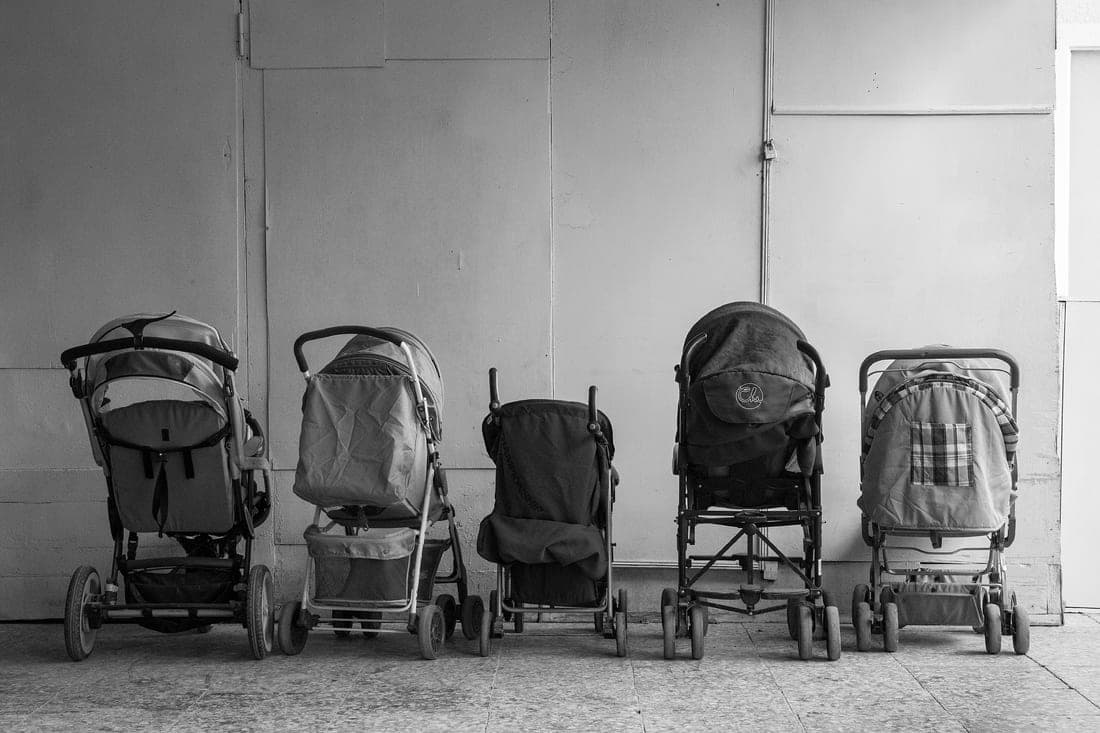
A row of strollers on display in a baby shop

Buckle & Buggy earns a commission when you buy through links on this page, at no extra cost to you. It does not change what we recommend or the order we rank things in — the criteria are published on our review methodology page, and the full terms are in our affiliate disclosure.

The short answer

Choose a stroller by answering six questions in this order: how many children, what ground, how often you fold and lift it, whether it must work from birth, what car it lives in, and what you can spend. Every other decision — fabric, brand, cup holders, color — follows from those six and changes nothing important. Most families who answer them honestly land on one of three strollers: a full-size stroller, a travel system, or a light stroller under 15 lb.

The reason stroller shopping feels impossible is that the reviews are organized by product and the decision is organized by life. A list of the thirty best strollers cannot tell you which to buy, because the thing that decides it is not in the list — it is in your hallway, your trunk and your sidewalk.

Question 1: how many children?

This is first because it is the only question that can make the stroller you buy today wrong in two years. A single stroller cannot become a double. A convertible frame can, and the premium for one is usually less than buying a single stroller now and a double later.

  • One child, and certain: a full-size single or a light stroller. Nothing else is needed.
  • A second child likely within three years: an expandable frame, or accept that you will buy again.
  • Two children already: side-by-side if they both need to sit, tandem or sit-and-stand if one is a toddler who climbs in and out. See best double strollers.
  • Twins: a frame that takes two infant car seats from day one, which most do not. See best travel systems for twins.

Question 2: what ground?

Wheel diameter and suspension decide whether a cracked sidewalk is an annoyance or a full stop, and this is where cheap strollers are genuinely worse rather than merely plainer. Small hard wheels drop into every expansion joint.

Ground conditions and what they require
Where you walkWhat you needWhere to look
Smooth floors, malls, parking lotsAnything. Small wheels are fineCheap lightweight strollers
City sidewalks, curbs, some broken pavementMid-size wheels, some suspensionBest baby strollers
Gravel paths, grass, trailsLarge air-filled tires, real suspensionBest jogging strollers
Airports, trains, stairsA one-motion fold and a carry strapBest foldable strollers

Question 3: how often do you fold and lift it?

The stroller you do not want to lift is the stroller you stop using, and this is the most under-weighted specification in the category. A 27 lb full-size stroller is pleasant to push and a genuine chore to lift into a high trunk ten times a week while holding a toddler.

Count the lifts in a normal week. If the answer is more than about ten, weight and fold should outrank push quality in your decision, and a stroller under 17 lb with a one-hand fold is worth more to you than a better ride. If the stroller lives in a hallway and goes out on foot, weight hardly matters.

Question 4: from birth, or from six months?

A newborn has to lie flat or near-flat, or ride in an infant car seat. A stroller seat that reclines a long way is not the same as one that lies flat, and the maker's published minimum age is the number to read — the UPPAbaby Minu V2, for instance, starts at 3 months.

  • A bassinet is the best newborn position and the most expensive route.
  • A flat-reclining seat does the same job on some full-size strollers, at no extra cost.
  • An infant car seat on an adapter is the cheapest and most common route, and it is why travel systems sell so well. The constraint is time: a car seat is not a bed, and the limits in how long a baby can stay in a car seat apply on a stroller frame too.

If you are weighing the bassinet against the car seat route specifically, that comparison has its own page: bassinet vs car seat for a newborn.

Question 5 and 6: the car, and the money

Measure the trunk. Not approximately — get the opening width and the floor depth in inches, and compare them with each stroller's published folded dimensions. This one measurement eliminates more strollers than any review will, and it is the most common cause of a returned stroller.

On budget, the useful question is not how much to spend but how to split it. One premium do-everything stroller, or a competent main stroller plus a cheap light one for the trunk? For many families the second split is better value, because no single stroller is good at both rough ground and airports.

01 — Families planning more children

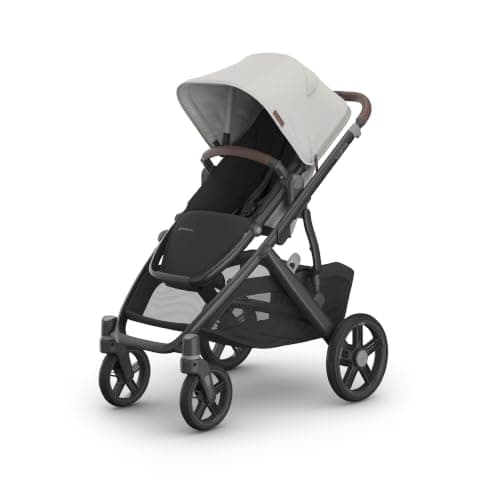
UPPAbaby Vista V3

UPPAbaby
UPPAbaby Vista V3
Our score8.7
Push and handling9.2
Fold and storage7.2
Weight6.6
Daily use9.4
Value7.6
$899.99 · View on Amazon

#ad We may earn a commission · Price as of October 19, 2026

One frame that carries one, two or three children, which is why it costs what it costs and why it is often still cheaper than buying twice.

The Vista's argument is arithmetic. The toddler seat takes a child to 50 lb, the RumbleSeat adds a second to 40 lb, and a PiggyBack board adds a third rider, so the frame you buy for a newborn is still the right frame after a second baby arrives. Against buying a single stroller now and a double later, the premium narrows a lot. It also includes a bassinet, which is the correct place for a newborn to lie flat on a long walk. It is not a small stroller: the frame with seat is 27.6 lb, the footprint is substantial in a small car trunk, and the whole system only makes sense if the expansion is actually in your plans. If you are certain you are having one child, the Cruz does most of this for less money and less bulk.

What works

  • Expands from one child to three on the same frame
  • Bassinet included, so a newborn can lie flat
  • 30 lb basket is the largest here

What to weigh

  • 27.6 lb and bulky folded
  • Only worth the price if you will actually use the expansion
  • Accessories to reach three children cost extra
Published specifications for the UPPAbaby Vista V3, with the source each figure was read from
SpecPublished figureRead from
Toddler seatTo 50 lbUPPAbaby product page
CapacityUp to three children with RumbleSeat and PiggyBackUPPAbaby product page
RumbleSeatTo 40 lbUPPAbaby product page
Weight27.6 lb frame with seatUPPAbaby product page
Basket30 lb capacityUPPAbaby product page

Verified as currently sold and checked against NHTSA's recall record on 2026-09-26; no recall named this model. Recalls apply to specific manufacture-date ranges, so check the date stamp on your own unit. Specifications come from the manufacturer or retailer listing.
02 — Most new parents

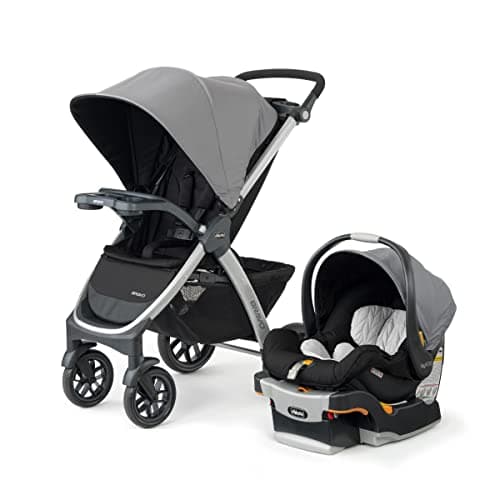
Chicco Bravo Trio with KeyFit 30

Chicco

Chicco Bravo Trio with KeyFit 30
Our score8.8
Install9.2
Push and handling8.0
Fit range8.2
Daily use9.0
Value9.2
$359.99 · View on Amazon

#ad We may earn a commission · Price as of October 19, 2026

A KeyFit 30 and a stroller that folds itself standing up, in the one box — the travel system we would buy without much deliberation.

A travel system is worth buying when the car seat in the box is one you would have chosen anyway, and the Bravo Trio clears that bar: the KeyFit 30 is a well-installing infant seat covering 4-30 lb and up to 30 in, with newborn support for 4-11 lb and a 9.5 lb carrier. The stroller takes a child to 50 lb and its one-hand self-standing fold is the feature you will use daily — it stays upright when folded instead of falling over in a garage. Three modes mean it goes from infant carrier to stroller seat without new parts. The limits are the KeyFit 30's 30 in height ceiling, which is shorter than the KeyFit 35, and a stroller that is competent rather than exciting to push. For most families that is the right trade.

What works

  • The included KeyFit 30 is a seat worth having on its own merits
  • Self-standing one-hand fold
  • Three modes with no extra parts to buy

What to weigh

  • KeyFit 30 tops out at 30 in, shorter than the KeyFit 35
  • Stroller push is competent rather than good
  • Bulky folded compared with a light stroller
Published specifications for the Chicco Bravo Trio with KeyFit 30, with the source each figure was read from
SpecPublished figureRead from
Stroller capacityTo 50 lbChicco product page
Infant seatKeyFit 30, 4-30 lb, up to 30 inChicco product page
Newborn support4-11 lbChicco product page
Carrier weight9.5 lbChicco product page
FoldOne-hand, self-standingChicco product page

Verified as currently sold and checked against NHTSA's recall record on 2026-09-26; no recall named this model. Recalls apply to specific manufacture-date ranges, so check the date stamp on your own unit. We do not print a star rating for this seat: NHTSA publishes an Ease-of-Use rating, and we would rather send you to the source than reprint a figure we could not read first-hand. Specifications come from the manufacturer or retailer listing.

03 — Under 15 lb with car seat compatibility

Graco NimbleLite

Graco

No image
Our score8.4
Push and handling6.8
Fold and storage8.4
Weight9.4
Daily use8.2
Value9.4
Check price on Amazon

#ad We may earn a commission · Amazon shows the current price

Under 15 lb, takes a 50 lb child, and accepts a Graco infant seat — a light stroller you can genuinely start with from birth.

Most sub-15 lb strollers cannot hold an infant car seat, which is why families end up buying a travel system first and a light stroller later. The NimbleLite does both: it is under 15 lb, takes a child to 50 lb, and clicks a Graco infant seat on top, so it can be your only stroller from the newborn stage. That makes it the best-value light stroller here for a family who does not want to buy twice. What you give up is refinement — the wheels are small and hard, the canopy is modest, and the push on rough pavement is not enjoyable. Fine for errands and travel, wrong for daily long walks.

What works

  • Under 15 lb and still takes an infant car seat
  • 50 lb capacity
  • Cheapest route to a light stroller usable from birth

What to weigh

  • Small hard wheels
  • Modest canopy
  • Not comfortable to push far on rough ground
Published specifications for the Graco NimbleLite, with the source each figure was read from
SpecPublished figureRead from
CapacityTo 50 lbRetailer listing
WeightUnder 15 lbRetailer listing
Car seatCompatible with Graco infant car seatsRetailer listing

Verified as currently sold and checked against NHTSA's recall record on 2026-09-26; no recall named this model. Recalls apply to specific manufacture-date ranges, so check the date stamp on your own unit. Specifications come from the manufacturer or retailer listing.

What not to decide on

  • Fabric and color. They do not change capacity, fold, weight or wheel size.
  • Cup holders and phone trays. Accessories, usually removable, never a reason to pick a frame.
  • Brand prestige on its own. A Graco NimbleLite under 15 lb carries the same 50 lb child as strollers costing several times more.
  • A showroom push on a flat polished floor. Every stroller pushes well on that surface. Ask to roll it over a door threshold instead.

When the shortlist is down to two or three models, the last step is a head-to-head rather than another roundup. Our matchups are at compare, and the model reviews are at reviews. Two further pages answer the questions that follow this one: best city strollers for the urban version of question two, and how to clean a stroller for the part nobody asks about until month four.

Frequently asked questions

How do I choose a stroller?

Answer six questions in order: how many children will ride in it over the next three years, what ground you push it over, how often you fold and lift it, whether it must work from birth, what car it has to fit in, and what you can spend. Those six eliminate most of the market. Fabric, brand and accessories decide nothing that matters.

What should I look for in a stroller?

The published numbers: weight capacity in pounds and inches, the stroller's own weight, folded dimensions, basket capacity and wheel diameter. Then the things a specification sheet cannot show — how many hands the fold needs and whether the folded stroller stands up. Everything else is preference.

Should I buy a travel system or a stroller and car seat separately?

Buy a travel system when the infant car seat in the box is a seat you would have chosen anyway, because then the bundle is a discount rather than a compromise. Buy separately when you want a specific car seat or a specific stroller — adapters exist for most popular combinations, and that route often produces a better stroller for similar money.

What size stroller do I need for my car?

Measure your trunk opening and floor depth in inches, then compare them with the stroller's published folded dimensions before buying. A full-size stroller fills most of a compact car's trunk, which is why families with small cars often choose a light stroller with a compact fold even when they walk on rough ground.

Do I need a jogging stroller if I only walk?

No. The air-filled tires and fixed front wheel that make a jogging stroller good at running speed make it long, wide and trunk-dominating the rest of the time, and the tires need a pump. If your walking includes gravel paths or grass, an all-terrain stroller with larger wheels is the better compromise.

When should I buy a stroller before the baby arrives?

Early enough to assemble it, fit it in the car and practice the fold before you need it, which in practice means the last trimester rather than the last week. If you are choosing a travel system, install the car seat base and have the installation checked while you still have time to exchange anything that does not fit your vehicle.