
Skip to content
By Janet H., Owner, Janet Media GroupLast updated How we research

Strollers

The best jogging strollers

Four features separate a running stroller from a stroller with big wheels. Three of them are safety features, and one of them is the reason cheap joggers are not joggers.

A parent running on a path while pushing a jogging stroller

Buckle & Buggy earns a commission when you buy through links on this page, at no extra cost to you. It does not change what we recommend or the order we rank things in — the criteria are published on our review methodology page, and the full terms are in our affiliate disclosure.

Our picks at a glance

A jogging stroller is not a stroller with larger wheels. Running with a child in front of you adds speed, sustained vibration and the need to stop quickly on a slope, and four features exist to handle exactly that:

  1. 1.A front wheel that locks straight. A swivel wheel is what you want in a shop and dangerous at running pace, where it can shimmy and turn abruptly. Every genuine jogger locks.
  2. 2.A hand brake. Not a parking brake — a brake you can apply while moving, for descents. The single feature most often missing from cheap joggers.
  3. 3.Real suspension. Running transmits continuous vibration to the child, and suspension is what absorbs it.
  4. 4.Air-filled tires. They roll over broken pavement, gravel, grass and roots, and they are why a jogger feels effortless on ground that stops a regular stroller.

A stroller missing the lock or the hand brake is a rough-terrain stroller, which is a genuinely useful thing to own, but it is not for running.

Our ranking — The best jogging strollers
#ProductBest forOur scorePrice
1
A parent running with a jogging stroller — category photo, not this specific modelCategory photo

BOB Gear Revolution Flex 3.0

A 75 lb capacity, 16 in rear wheels and a handlebar that adjusts from 34.5 to 48 in — the jogging stroller that fits both parents and keeps working on trails.

Running on rough ground8.7out of 10
2
A parent running with a jogging stroller — category photo, not this specific modelCategory photo

Thule Urban Glide 3

26.2 lb with a compact fold — the jogging stroller that is still pleasant to live with when you are not running.

Running on pavement8.8out of 10
3
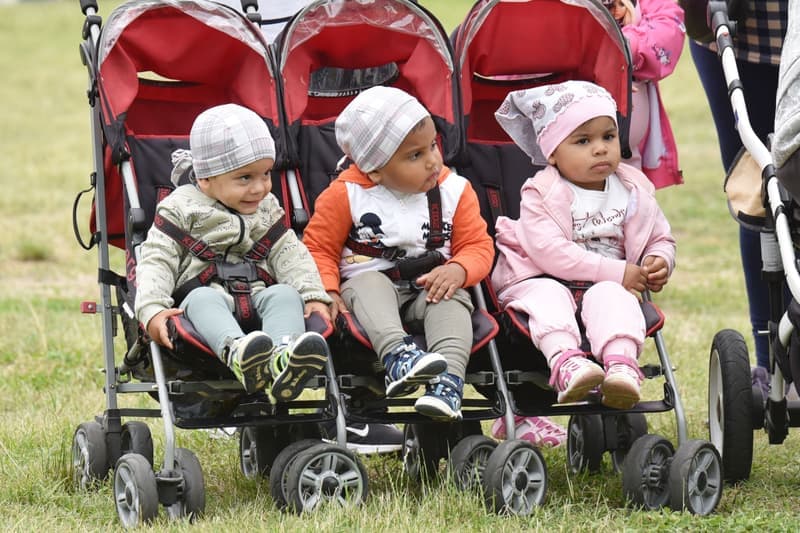
Two children riding in a double stroller — category photo, not this specific modelCategory photo

Baby Jogger City Mini GT2 Double

50 lb per seat, all-wheel suspension and a one-step fold at 29.25 in wide — the side-by-side double that actually fits through a doorway.

Two children, side by side8.8out of 10

Rows link to the full assessment further down this page. Scores are our own editorial ratings against the criteria on our methodology page — they are not crash-test results and not a NHTSA or IIHS rating.

How we chose

We ranked on running capability first and everyday usability second, because most jogging strollers spend more hours walking than running and a jogger you resent using at the shops gets left at home.

  • Front wheel lock, and how positive and quick it is to engage.
  • Hand brake presence and quality, weighted heavily — this is a safety feature on any hill.
  • Suspension travel and adjustability.
  • Tire size and type, and how easy the tires are to inflate and repair.
  • Everyday usability — folded size, basket, canopy, whether the swivel makes it tolerable indoors.
  • Car seat compatibility, for the months before a baby can ride in the seat.

Every figure below was read from the manufacturer's own page on the date shown and checked against published recall records. We have not run a marathon behind any of these — see the methodology page for exactly what we did and did not do.

The picks in detail

01 — Running on rough ground

BOB Gear Revolution Flex 3.0

BOB Gear
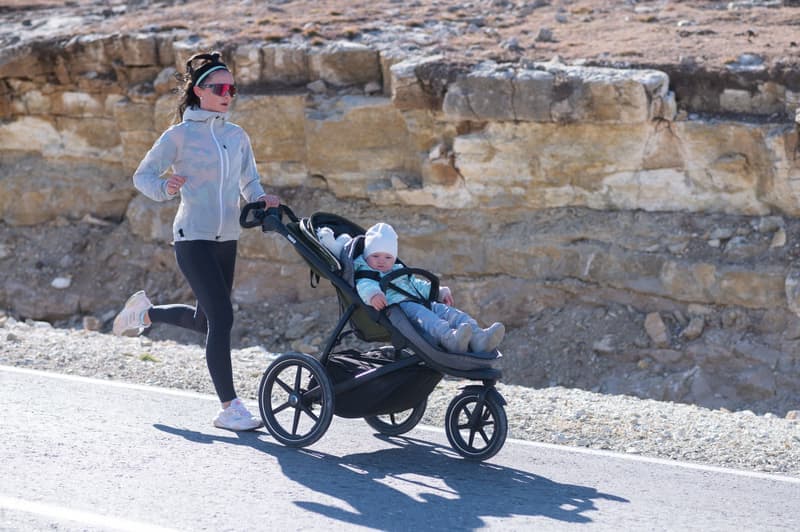
A parent running with a jogging stroller — category photo, not this specific modelCategory photo
Our score8.7
Push and handling9.6
Fold and storage6.8
Weight7.4
Daily use8.4
Value8.2
Check price on Amazon

#ad We may earn a commission · Amazon shows the current price

A 75 lb capacity, 16 in rear wheels and a handlebar that adjusts from 34.5 to 48 in — the jogging stroller that fits both parents and keeps working on trails.

If you actually run, the two specs that decide whether a jogging stroller gets used are wheel size and handlebar range. The Revolution Flex 3.0 has 16 in rear and 12 in front air-filled tires, which roll over roots and gravel instead of stopping on them, and a handlebar that adjusts across 13.5 in — enough that a 5 ft 3 in and a 6 ft 2 in parent can both push it without clipping their shins. Capacity is 75 lb, the highest here, and it takes 28 lb of that itself. The trade-offs come with the format: it is long, it is wide, and it takes up a boot. Air tires also need a pump. Remember that jogging with a baby waits until a doctor confirms they have the neck control for it, and that the fixed-wheel mode is the one to use when running.

What works

  • 75 lb capacity — the highest here
  • Big air tires genuinely handle trails
  • 13.5 in of handlebar adjustment fits parents of very different heights

What to weigh

  • Long and wide — dominates a boot
  • Air tires need a pump and can puncture
  • Overkill if you only walk
Published specifications for the BOB Gear Revolution Flex 3.0, with the source each figure was read from
SpecPublished figureRead from
Capacity75 lbRetailer specification sheet
Weight28 lbRetailer specification sheet
Tires16 in rear, 12 in front, air-filledRetailer specification sheet
HandlebarAdjusts 34.5-48 inRetailer specification sheet
Warranty5-year frame, 1-year soft goodsRetailer specification sheet

Verified as currently sold and checked against NHTSA's recall record on 2026-09-26; no recall named this model. Recalls apply to specific manufacture-date ranges, so check the date stamp on your own unit. Specifications come from the manufacturer or retailer listing.

02 — Running on pavement

Thule Urban Glide 3

Thule

A parent running with a jogging stroller — category photo, not this specific modelCategory photo
Our score8.8
Push and handling9.4
Fold and storage8.6
Weight8.0
Daily use9.2
Value7.6
Check price on Amazon

#ad We may earn a commission · Amazon shows the current price

26.2 lb with a compact fold — the jogging stroller that is still pleasant to live with when you are not running.

The BOB is the better trail stroller; the Urban Glide 3 is the better everyday one. It is 26.2 lb against the BOB's 28 lb, folds to 34.6 by 22.8 by 12.2 in, and handles beautifully on pavement and packed paths. The number to read carefully is the capacity: 75 lb total but a 49 lb maximum child weight, which is lower than the BOB's 75 lb per child and will end this stroller's useful life earlier for a tall kid. The cargo basket holds 15 lb with a zip-top cover, which is more usable than most. Choose it if your running is roads and park paths and the stroller also has to be your daily one; choose the BOB if the ground is genuinely rough.

What works

  • 26.2 lb and a genuinely compact fold for a jogger
  • Excellent on pavement and packed paths
  • Covered 15 lb cargo basket

What to weigh

  • 49 lb maximum child weight ends its life earlier than the BOB
  • Less capable than the BOB on rough trails
  • Premium price
Published specifications for the Thule Urban Glide 3, with the source each figure was read from
SpecPublished figureRead from
Capacity75 lb total, 49 lb maximum child weightThule product page
Weight26.2 lbThule product page
Folded size34.6 x 22.8 x 12.2 inThule product page
Basket15 lb, zip-top coverThule product page

Verified as currently sold and checked against NHTSA's recall record on 2026-09-26; no recall named this model. Recalls apply to specific manufacture-date ranges, so check the date stamp on your own unit. Specifications come from the manufacturer or retailer listing.

03 — Two children, side by side

Baby Jogger City Mini GT2 Double

Baby Jogger

Two children riding in a double stroller — category photo, not this specific modelCategory photo
Our score8.8
Push and handling9.2
Fold and storage8.8
Weight6.4
Daily use9.2
Value8.4
Check price on Amazon

#ad We may earn a commission · Amazon shows the current price

50 lb per seat, all-wheel suspension and a one-step fold at 29.25 in wide — the side-by-side double that actually fits through a doorway.

The hard constraint on a side-by-side double is width, because a stroller that will not go through a shop door is a stroller you stop using. At 29.25 in open the City Mini GT2 Double clears standard doorways, and it carries 50 lb per seat for 100 lb total, which outlasts most doubles. The one-step fold is the feature parents rate highest in daily use: lift both in-seat straps and it folds itself, which is achievable with a child on your hip. Forever Air tires and all-wheel suspension handle broken pavement and gravel paths without needing a full jogging stroller. It is 34.7 lb, so lifting it into a boot is a two-handed job, and both seats recline independently but neither lies fully flat, so newborn use needs a car seat or bassinet adapter. For twins or two close-in-age children, this is the default.

What works

  • 29.25 in clears standard doorways, unlike many side-by-sides
  • One-step fold you can do holding a child
  • 50 lb per seat outlasts most doubles

What to weigh

  • 34.7 lb to lift into a boot
  • Neither seat lies fully flat, so a newborn needs an adapter
  • Takes up most of a small car's boot folded
Published specifications for the Baby Jogger City Mini GT2 Double, with the source each figure was read from
SpecPublished figureRead from
Capacity50 lb per seat, 100 lb totalBaby Jogger product page
Open width29.25 inBaby Jogger product page
Weight34.7 lbBaby Jogger product page
FoldOne-step, lift both in-seat strapsBaby Jogger product page
RideForever Air tires, all-wheel suspensionBaby Jogger product page

Verified as currently sold and checked against NHTSA's recall record on 2026-09-26; no recall named this model. Recalls apply to specific manufacture-date ranges, so check the date stamp on your own unit. Specifications come from the manufacturer or retailer listing.

When can a baby go running with you?

Later than most people assume, and this is the most important thing on this page. Running subjects a child to sustained vibration and repeated small impacts, and a young infant lacks the head and neck control to tolerate that. The commonly-cited guidance is to wait until at least six to eight months, and to ask your pediatrician about your specific child rather than treating a number as permission.

Two things follow from that. First, a car seat adapter makes a jogging stroller usable from birth for walking, and that is all it makes it usable for — an infant car seat clicked onto a jogger is not a running configuration. Second, if you want to run in the first months, the honest answer is a treadmill, a running buddy, or a different plan; a jogger bought in pregnancy will be a walking stroller for the better part of a year.

Who should buy one even if they never run

A surprising number of the people who should buy a jogging stroller do not run at all. The features that make one good at running — big air-filled tires, a long wheelbase, suspension — also make it by far the most capable stroller on broken sidewalks, gravel paths, packed trails, grass, snow and curbs. If your daily walk involves any of those, a jogger will feel like a different class of product.

What you pay for that is a big fold, real weight, and clumsy handling in shops and lifts. If your walking is mostly smooth pavement and indoor errands, you are buying capability you will not use and carrying the penalty every day — a lightweight stroller is the better tool.

Frequently asked questions

When can I start running with my baby in a jogging stroller?

Commonly cited guidance is to wait until at least six to eight months, and to check with your pediatrician about your own child first. The reason is head and neck control: running transmits sustained vibration and repeated small impacts that a young infant cannot stabilize against. Before that point a jogging stroller is a walking stroller, and a car seat adapter does not change that.

Do I need the front wheel to lock?

Yes, and it is the feature that defines the category. At running speed a swivel front wheel can shimmy or turn abruptly, which is exactly the failure you cannot recover from while moving quickly. Every genuine jogging stroller has a lock, and locking it is a habit to build for every run. Unlock it for walking, where the swivel is what makes the stroller usable.

What is a hand brake for on a stroller?

Controlling speed on a descent while you are still moving, which a foot-operated parking brake cannot do. It is the feature most often missing from cheap strollers sold as joggers, and on any route with hills it is the difference between managing a descent and chasing the stroller. Treat its absence as disqualifying if you will run anywhere other than flat ground.

Are air-filled tires worth the maintenance?

If you use rough ground, yes. Air-filled tires roll over broken pavement, gravel, grass and roots in a way foam-filled tires simply do not, and they absorb vibration before the suspension has to. The cost is checking pressure occasionally and being able to fix a flat. If you only use smooth pavement, foam-filled is a legitimate choice and one less thing to maintain.

Can a jogging stroller be my only stroller?

It can, and plenty of families do it, but be honest about the trade. You get a stroller that handles any surface and pushes beautifully, and you accept a large fold, real weight and awkwardness indoors and in lifts. Many families end up with a jogger plus a cheap lightweight stroller for travel and errands, which covers both cases for less than one premium stroller.

Can I use a jogging stroller with a newborn?

For walking, yes, if it accepts an infant car seat adapter or has a flat-reclining seat or bassinet option — check the manufacturer's from-birth statement. For running, no. And remember an infant car seat on a stroller frame has practical time limits of its own, so a car seat adapter is transport rather than a place for a long nap.