Skip to content
By Janet H., Owner, Janet Media GroupPublished How we research

Strollers

What age to stop using a stroller?

There is no age at which a stroller becomes wrong. There is a weight limit, a walking distance and a social moment, and they rarely arrive together.

An older child riding in a stroller on a long day out

Buckle & Buggy earns a commission when you buy through links on this page, at no extra cost to you. It does not change what we recommend or the order we rank things in — the criteria are published on our review methodology page, and the full terms are in our affiliate disclosure.

The direct answer

Most children stop using a stroller between three and four years old, and the thing that actually ends it is the stroller's weight limit rather than a birthday. Typical single strollers are rated to 50 lb, which an average child reaches around age six or seven — so in practice families stop long before the stroller does, usually because the child walks far enough that pushing an empty stroller stops being worth it. There is no age at which using a stroller becomes developmentally wrong, and no published guideline that names one.

The more useful question is when to stop using it for ordinary daily trips, and the answer there is: when your child can comfortably walk the distance you normally cover, with the energy left over to behave like themselves at the other end. That is usually somewhere in the third year. Long days — theme parks, city sightseeing, airports — are a separate case, and plenty of five- and six-year-olds ride in a stroller on those days for entirely sensible reasons.

Three different limits, and they do not arrive together

The confusion in this question comes from treating one decision as three. Separate them and it gets simple.

The three things that end stroller use
LimitWhen it arrivesWhat it means
The hard limit50 lb on most single strollers — roughly age six or sevenA real safety boundary. Past it the frame, brakes and fold are outside their tested range
The practical limitUsually age three to fourYour child walks your normal distance, so the stroller becomes a thing you push empty
The long-day exceptionContinues to the hard limitTheme parks, airports and sightseeing days where the distance is far beyond normal

Treat the hard limit as non-negotiable: a stroller carrying more weight than it is rated for has longer stopping distances, a less predictable fold and a frame outside its tested range. Check your own model's published figure rather than assuming 50 lb — the Thule Urban Glide 3, for instance, publishes 75 lb total capacity but a 49 lb maximum child weight, and the child figure is the one that matters here.

What to look for if you need it to last longer

Some families genuinely need the stroller for another year or two — a long commute on foot, a child with additional needs, a sibling arriving. These are the specifications that extend its useful life.

  • The published child weight limit, not the total capacity. 50 lb is the common figure; some strollers publish less for the child specifically.
  • Seat depth and height, which usually run out before the weight limit does. A child whose knees are past the end of the seat is finished with that stroller regardless of the scale.
  • A canopy that still covers a taller child. An extendable canopy is the difference between shade and a sunburn on a park day.
  • A frame that converts. The UPPAbaby Vista V3 carries a 50 lb toddler seat and adds a RumbleSeat to 40 lb, which keeps one frame useful across two children rather than two stages.
  • A ride a bigger child will tolerate. A 40 lb child feels every seam through small hard wheels. This is where a jogger's tires earn their keep.

01 — Families planning more children

UPPAbaby Vista V3

UPPAbaby
UPPAbaby Vista V3
Our score8.7
Push and handling9.2
Fold and storage7.2
Weight6.6
Daily use9.4
Value7.6
$899.99 · View on Amazon

#ad We may earn a commission · Price as of October 19, 2026

One frame that carries one, two or three children, which is why it costs what it costs and why it is often still cheaper than buying twice.

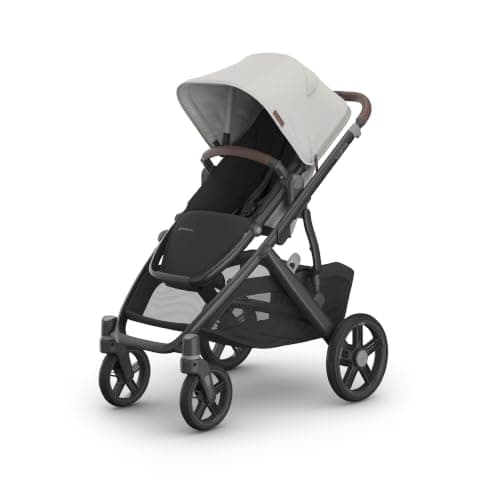
The Vista's argument is arithmetic. The toddler seat takes a child to 50 lb, the RumbleSeat adds a second to 40 lb, and a PiggyBack board adds a third rider, so the frame you buy for a newborn is still the right frame after a second baby arrives. Against buying a single stroller now and a double later, the premium narrows a lot. It also includes a bassinet, which is the correct place for a newborn to lie flat on a long walk. It is not a small stroller: the frame with seat is 27.6 lb, the footprint is substantial in a small car trunk, and the whole system only makes sense if the expansion is actually in your plans. If you are certain you are having one child, the Cruz does most of this for less money and less bulk.

What works

  • Expands from one child to three on the same frame
  • Bassinet included, so a newborn can lie flat
  • 30 lb basket is the largest here

What to weigh

  • 27.6 lb and bulky folded
  • Only worth the price if you will actually use the expansion
  • Accessories to reach three children cost extra
Published specifications for the UPPAbaby Vista V3, with the source each figure was read from
SpecPublished figureRead from
Toddler seatTo 50 lbUPPAbaby product page
CapacityUp to three children with RumbleSeat and PiggyBackUPPAbaby product page
RumbleSeatTo 40 lbUPPAbaby product page
Weight27.6 lb frame with seatUPPAbaby product page
Basket30 lb capacityUPPAbaby product page

Verified as currently sold and checked against NHTSA's recall record on 2026-09-26; no recall named this model. Recalls apply to specific manufacture-date ranges, so check the date stamp on your own unit. Specifications come from the manufacturer or retailer listing.
02 — Running on pavement

Thule Urban Glide 3

Thule

Thule Urban Glide 3
Our score8.8
Push and handling9.4
Fold and storage8.6
Weight8.0
Daily use9.2
Value7.6
$799.95 · View on Amazon

#ad We may earn a commission · Price as of October 19, 2026

26.2 lb with a compact fold — the jogging stroller that is still pleasant to live with when you are not running.

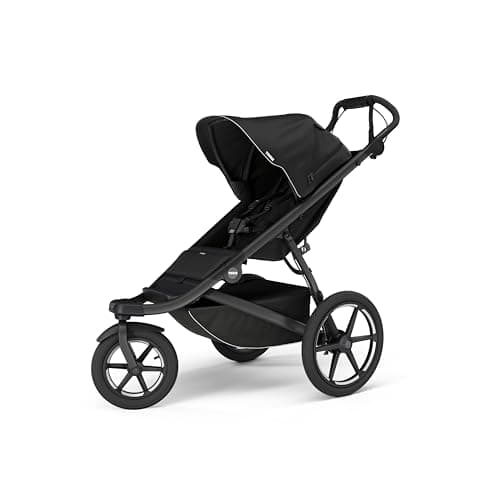
The BOB is the better trail stroller; the Urban Glide 3 is the better everyday one. It is 26.2 lb against the BOB's 28 lb, folds to 34.6 by 22.8 by 12.2 in, and handles beautifully on pavement and packed paths. The number to read carefully is the capacity: 75 lb total but a 49 lb maximum child weight, which is lower than the BOB's 75 lb per child and will end this stroller's useful life earlier for a tall kid. The cargo basket holds 15 lb with a zip-top cover, which is more usable than most. Choose it if your running is roads and park paths and the stroller also has to be your daily one; choose the BOB if the ground is genuinely rough.

What works

  • 26.2 lb and a genuinely compact fold for a jogger
  • Excellent on pavement and packed paths
  • Covered 15 lb cargo basket

What to weigh

  • 49 lb maximum child weight ends its life earlier than the BOB
  • Less capable than the BOB on rough trails
  • Premium price
Published specifications for the Thule Urban Glide 3, with the source each figure was read from
SpecPublished figureRead from
Capacity75 lb total, 49 lb maximum child weightThule product page
Weight26.2 lbThule product page
Folded size34.6 x 22.8 x 12.2 inThule product page
Basket15 lb, zip-top coverThule product page

Verified as currently sold and checked against NHTSA's recall record on 2026-09-26; no recall named this model. Recalls apply to specific manufacture-date ranges, so check the date stamp on your own unit. Specifications come from the manufacturer or retailer listing.

03 — Cheapest useful umbrella stroller

Summer by Ingenuity 3Dlite

Summer by Ingenuity

Summer by Ingenuity 3Dlite
Our score8.2
Push and handling6.8
Fold and storage7.8
Weight9.2
Daily use7.8
Value9.8
$99.99 · View on Amazon

#ad We may earn a commission · Price as of October 19, 2026

An aluminum frame at 13 lb with a four-position recline and a 50 lb limit, for a fraction of what the premium light strollers cost.

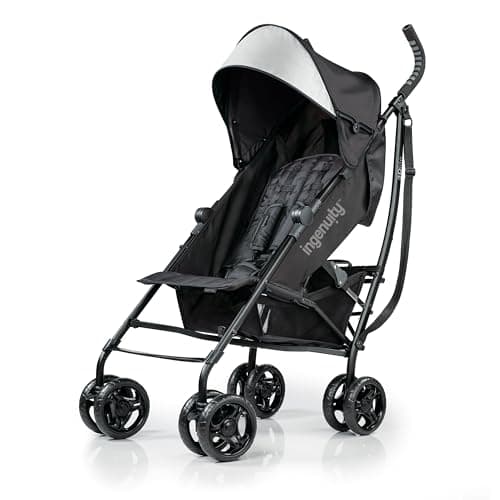
Most cheap umbrella strollers cannot recline, which makes them useless the moment a toddler falls asleep. The 3Dlite can, across four positions, and that single feature is why it is worth more than its price suggests. It takes a child to 50 lb and up to 43 in, the aluminum frame keeps it to 13 lb, and it has a 5-point harness and a storage basket that actually holds something. The compromises are the honest ones for the price: small hard wheels, a narrow canopy, and a fold that is quick but leaves a long floppy package rather than a neat one. As a second stroller for the trunk of the car, or the one that lives at grandparents', it is the right buy.

What works

  • Four-position recline at a price where most strollers have none
  • 13 lb aluminum frame
  • 50 lb limit is generous for the category

What to weigh

  • Small hard wheels
  • Narrow canopy
  • Folds long and floppy rather than compact
Published specifications for the Summer by Ingenuity 3Dlite, with the source each figure was read from
SpecPublished figureRead from
Capacity50 lb, up to 43 inKids2 product page
Weight13 lb, aluminum frameKids2 product page
Recline4 positionsKids2 product page

Verified as currently sold and checked against NHTSA's recall record on 2026-09-26; no recall named this model. Recalls apply to specific manufacture-date ranges, so check the date stamp on your own unit. Specifications come from the manufacturer or retailer listing.

The three above cover the common cases: a convertible frame for a growing family, a jogger for the family that walks long distances on uneven ground, and a cheap umbrella stroller for the theme-park and airport days that keep happening after everyday use has ended — the Summer by Ingenuity 3Dlite is 13 lb, carries to 50 lb and up to 43 in, and costs little enough to live in a trunk. The full list is best strollers for big kids.

Is using a stroller too long bad for a child?

This is the anxiety behind the search, so it deserves a direct answer rather than a hedge. There is no published guideline from a major pediatric body setting an age at which stroller use becomes harmful, and the plausible concerns — less walking, less independence — are about how much a child walks overall rather than about the stroller itself. A child who walks to the park and rides home is walking. A child who is pushed everywhere, every day, at five, probably is not, and that is a pattern worth noticing.

What is worth avoiding is the other failure mode: pushing a tired three-year-old to walk distances they cannot manage, which ends days early and teaches nobody anything. The sensible middle is a stroller that comes along on long days and stays home on short ones. The guidance on how long a child should be in any semi-upright seat in one stretch — which does apply, and does have numbers behind it — is in how long can a baby stay in a car seat.

What comes after the stroller

For most families, nothing — the child walks, and the stroller goes to a sibling or is sold. For the long-day problem, the usual answer is a cheap folding stroller kept for trips, which is why umbrella strollers continue to sell to families whose children are well past everyday stroller age. Wagons look like the answer and often are not: Walt Disney World, for instance, prohibits wagons and stroller wagons at its theme parks outright, so check the rules of the place you are actually going before buying one.

The car seat timeline is a different and much longer one, and the two are routinely confused. A child out of a stroller at four is still several years from being out of a booster — see when can a child stop using a booster seat.

Frequently asked questions

What age should a child stop using a stroller?

Most families stop between three and four years old, when the child can comfortably walk the distances you normally cover. There is no published pediatric guideline naming an age. The stroller's own limit is usually 50 lb, which an average child reaches around six or seven, so the hardware rarely decides it.

What is the weight limit on a stroller?

Commonly 50 lb for a single stroller, but check your own model. Some publish a lower child limit than their total capacity — the Thule Urban Glide 3 states 75 lb total with a 49 lb maximum child weight. Exceeding the published child limit affects braking, folding and frame loads.

Is it bad to use a stroller for too long?

No major pediatric body sets an age at which stroller use becomes harmful. The reasonable concern is total daily activity rather than the stroller itself: a child who walks to the park and rides home is walking. A child pushed everywhere at five probably is not, and that is the pattern to watch rather than the birthday.

Can a 5 year old use a stroller?

Yes, if they are within the stroller's published weight and height limits and still fit the seat. It is common and sensible on long days — theme parks, airports, city sightseeing — where the walking distance is far beyond a normal day. Many families keep a cheap folding stroller for exactly this.

What ends stroller use first, weight or seat size?

Usually seat size. A child whose knees are past the end of the seat or whose head is above the canopy is finished with that stroller regardless of what the scale says. Check the fit visually as well as checking the published limits.

Should I buy a wagon instead for an older child?

Check where you are going first. Walt Disney World prohibits wagons and stroller wagons at its theme parks, and other venues have their own rules. A light folding stroller is more widely accepted and far easier to put on a bus or in a trunk.