
Skip to content
By Janet H., Owner, Janet Media GroupPublished How we research

Strollers

When can a baby sit in a stroller?

Two answers, often months apart: what the stroller's instructions allow, and what your baby's head and trunk control allow.

A baby sitting upright in a stroller seat outdoors

Buckle & Buggy earns a commission when you buy through links on this page, at no extra cost to you. It does not change what we recommend or the order we rank things in — the criteria are published on our review methodology page, and the full terms are in our affiliate disclosure.

The short answer

A baby can use the stroller seat upright once they can hold their head steady and sit unsupported — commonly around six months — and can use a flat-reclining stroller seat much earlier, from birth, if the maker allows it. Before that point the baby rides in a bassinet or in an infant car seat on the frame. Two numbers govern the decision: your stroller's published minimum age or recline requirement, and your baby's own head and trunk control. Whichever is later is the right answer.

The confusion in this question comes from strollers being sold as one product with three configurations. The same frame might take a bassinet from birth, a car seat from birth, a fully reclined seat from some published minimum, and an upright seat from around six months. So when can my baby sit in the stroller has four different right answers depending on which part you mean.

The readiness signs that actually matter

An upright seat asks a baby to support their own head and trunk against the movement of a stroller. Before they can do that, the head drops forward in a way that narrows the airway — which is the same mechanism that makes long stretches in a car seat a problem for a newborn.

  • Steady head control. The head stays up when the baby is held upright, rather than bobbing or dropping forward.
  • Sitting unsupported, even briefly, on a flat surface. This is the clearest single sign, and it is where most guidance lands for upright stroller use.
  • No slumping sideways in a part-reclined seat with the harness snug.
  • The stroller's own published minimum, which can be later than your baby's development. Some light strollers publish a three-month floor regardless of the baby.

Babies reach these at different times and prematurity shifts the whole timeline, so use the signs rather than the calendar. If you are unsure, your pediatrician can tell you in thirty seconds at a routine check.

What the strollers themselves allow

The maker's instructions override everything in the previous section, because they reflect what that specific seat was tested in. Three patterns cover most strollers on sale.

The three published patterns, and what they mean in practice
What the stroller publishesWhat it meansExample
Newborn-ready with a flat recline or bassinetUsable from birth without a car seat, in the flattest position onlyFull-size strollers with a near-flat seat; the Vista V3 includes a bassinet
Car seat compatible, seat from a stated ageBirth to around six months happens in the infant car seat on the frameTravel systems, and light strollers like the Graco NimbleLite
A published minimum age for the seatThe seat is not approved below that age in any reclineCompact travel strollers — the UPPAbaby Minu V2 publishes 3 months

If you bought second-hand and have no manual, almost every manufacturer publishes them as a download by model name. It is worth the five minutes: the alternative is guessing about the one thing in this question that is not a judgment call.

The car seat stretch, and why it has a limit

Until the stroller seat is usable, the default is the infant car seat clipped to the frame — which is convenient and has a catch. A car seat holds a baby semi-upright, and that is a transport position, not a resting one. Clipping it to a stroller does not change the angle or the risk, so the sensible pattern is short stretches, out at the destination, and a bassinet or flat seat for long outings.

The full version of this, with the reasoning and the time guidance, is in how long a baby can stay in a car seat. If you are deciding between buying the bassinet and relying on the car seat, that trade-off has its own page: bassinet vs car seat for a newborn.

01 — Families planning more children

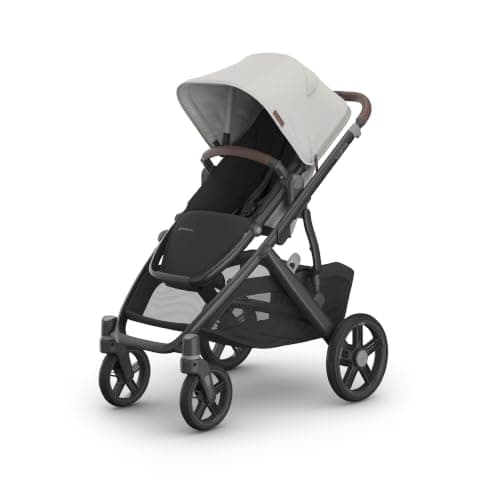
UPPAbaby Vista V3

UPPAbaby
UPPAbaby Vista V3
Our score8.7
Push and handling9.2
Fold and storage7.2
Weight6.6
Daily use9.4
Value7.6
$899.99 · View on Amazon

#ad We may earn a commission · Price as of October 19, 2026

One frame that carries one, two or three children, which is why it costs what it costs and why it is often still cheaper than buying twice.

The Vista's argument is arithmetic. The toddler seat takes a child to 50 lb, the RumbleSeat adds a second to 40 lb, and a PiggyBack board adds a third rider, so the frame you buy for a newborn is still the right frame after a second baby arrives. Against buying a single stroller now and a double later, the premium narrows a lot. It also includes a bassinet, which is the correct place for a newborn to lie flat on a long walk. It is not a small stroller: the frame with seat is 27.6 lb, the footprint is substantial in a small car trunk, and the whole system only makes sense if the expansion is actually in your plans. If you are certain you are having one child, the Cruz does most of this for less money and less bulk.

What works

  • Expands from one child to three on the same frame
  • Bassinet included, so a newborn can lie flat
  • 30 lb basket is the largest here

What to weigh

  • 27.6 lb and bulky folded
  • Only worth the price if you will actually use the expansion
  • Accessories to reach three children cost extra
Published specifications for the UPPAbaby Vista V3, with the source each figure was read from
SpecPublished figureRead from
Toddler seatTo 50 lbUPPAbaby product page
CapacityUp to three children with RumbleSeat and PiggyBackUPPAbaby product page
RumbleSeatTo 40 lbUPPAbaby product page
Weight27.6 lb frame with seatUPPAbaby product page
Basket30 lb capacityUPPAbaby product page

Verified as currently sold and checked against NHTSA's recall record on 2026-09-26; no recall named this model. Recalls apply to specific manufacture-date ranges, so check the date stamp on your own unit. Specifications come from the manufacturer or retailer listing.
02 — Most new parents

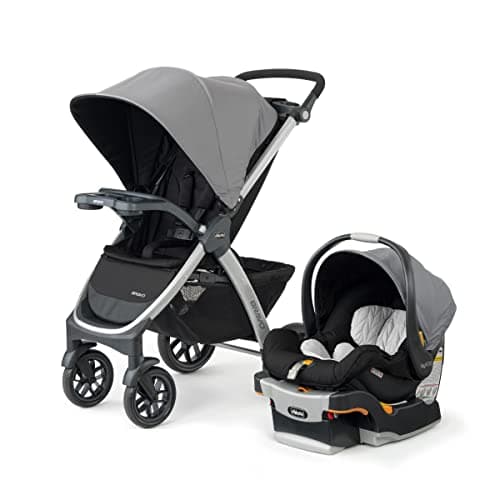
Chicco Bravo Trio with KeyFit 30

Chicco

Chicco Bravo Trio with KeyFit 30
Our score8.8
Install9.2
Push and handling8.0
Fit range8.2
Daily use9.0
Value9.2
$359.99 · View on Amazon

#ad We may earn a commission · Price as of October 19, 2026

A KeyFit 30 and a stroller that folds itself standing up, in the one box — the travel system we would buy without much deliberation.

A travel system is worth buying when the car seat in the box is one you would have chosen anyway, and the Bravo Trio clears that bar: the KeyFit 30 is a well-installing infant seat covering 4-30 lb and up to 30 in, with newborn support for 4-11 lb and a 9.5 lb carrier. The stroller takes a child to 50 lb and its one-hand self-standing fold is the feature you will use daily — it stays upright when folded instead of falling over in a garage. Three modes mean it goes from infant carrier to stroller seat without new parts. The limits are the KeyFit 30's 30 in height ceiling, which is shorter than the KeyFit 35, and a stroller that is competent rather than exciting to push. For most families that is the right trade.

What works

  • The included KeyFit 30 is a seat worth having on its own merits
  • Self-standing one-hand fold
  • Three modes with no extra parts to buy

What to weigh

  • KeyFit 30 tops out at 30 in, shorter than the KeyFit 35
  • Stroller push is competent rather than good
  • Bulky folded compared with a light stroller
Published specifications for the Chicco Bravo Trio with KeyFit 30, with the source each figure was read from
SpecPublished figureRead from
Stroller capacityTo 50 lbChicco product page
Infant seatKeyFit 30, 4-30 lb, up to 30 inChicco product page
Newborn support4-11 lbChicco product page
Carrier weight9.5 lbChicco product page
FoldOne-hand, self-standingChicco product page

Verified as currently sold and checked against NHTSA's recall record on 2026-09-26; no recall named this model. Recalls apply to specific manufacture-date ranges, so check the date stamp on your own unit. We do not print a star rating for this seat: NHTSA publishes an Ease-of-Use rating, and we would rather send you to the source than reprint a figure we could not read first-hand. Specifications come from the manufacturer or retailer listing.

03 — Under 15 lb with car seat compatibility

Graco NimbleLite

Graco

No image
Our score8.4
Push and handling6.8
Fold and storage8.4
Weight9.4
Daily use8.2
Value9.4
Check price on Amazon

#ad We may earn a commission · Amazon shows the current price

Under 15 lb, takes a 50 lb child, and accepts a Graco infant seat — a light stroller you can genuinely start with from birth.

Most sub-15 lb strollers cannot hold an infant car seat, which is why families end up buying a travel system first and a light stroller later. The NimbleLite does both: it is under 15 lb, takes a child to 50 lb, and clicks a Graco infant seat on top, so it can be your only stroller from the newborn stage. That makes it the best-value light stroller here for a family who does not want to buy twice. What you give up is refinement — the wheels are small and hard, the canopy is modest, and the push on rough pavement is not enjoyable. Fine for errands and travel, wrong for daily long walks.

What works

  • Under 15 lb and still takes an infant car seat
  • 50 lb capacity
  • Cheapest route to a light stroller usable from birth

What to weigh

  • Small hard wheels
  • Modest canopy
  • Not comfortable to push far on rough ground
Published specifications for the Graco NimbleLite, with the source each figure was read from
SpecPublished figureRead from
CapacityTo 50 lbRetailer listing
WeightUnder 15 lbRetailer listing
Car seatCompatible with Graco infant car seatsRetailer listing

Verified as currently sold and checked against NHTSA's recall record on 2026-09-26; no recall named this model. Recalls apply to specific manufacture-date ranges, so check the date stamp on your own unit. Specifications come from the manufacturer or retailer listing.

Forward-facing, and the questions that follow

Turning the seat to face forward is not a safety milestone the way it is in a car. In a stroller it is a preference: facing you is better for interaction and for watching a young baby, facing out is better once a baby is curious about the world and can hold their head up to look at it. Either is fine at any age the seat itself allows, and reversible seats exist so you can switch.

Two more things change around the same time. The harness needs tightening as the baby becomes mobile — a snug 5-point harness is the only thing between a curious nine-month-old and the footrest. And this is usually when parents discover whether their stroller suits the ground they walk on, because a sitting baby takes longer outings than a sleeping one. If yours does not, how to choose a stroller covers what to look at next, and best strollers for toddlers covers the stage after this one. The other end of the same timeline is what age to stop using a stroller.

Frequently asked questions

When can a baby sit in a stroller without a car seat?

Once they can hold their head steady and sit unsupported, which is commonly around six months, they can use the stroller seat upright. Earlier than that they can use a stroller seat that reclines flat or near-flat if the manufacturer allows it, which many full-size strollers do from birth. Before either, the baby rides in a bassinet or an infant car seat on the frame.

Can a newborn go in a stroller seat?

Only if the stroller's instructions permit it and the seat lies flat or near-flat. A newborn cannot support their own head, and a semi-upright seat lets the chin drop toward the chest, which narrows the airway. Compact travel strollers often publish a minimum age for the seat — the UPPAbaby Minu V2 states 3 months — and that figure governs regardless of how developed the baby seems.

When can a baby face forward in a stroller?

Whenever the seat allows it and you prefer it. Unlike a car seat, forward-facing in a stroller is not a safety threshold — it is a visibility choice. Facing the parent suits a young baby and makes it easier to watch them; facing out suits a baby who is interested in the world and can hold their head up to look at it.

How do I know my baby is ready for an upright stroller seat?

Look for steady head control when held upright, the ability to sit unsupported even briefly, and no sideways slumping in a part-reclined seat with the harness snug. Then check your stroller's published minimum, which can be later than the baby's development. Ask your pediatrician at a routine check if you are not sure — it takes them seconds to assess.

Is it bad for a baby to sit in a stroller too long?

In an upright stroller seat, a baby who can sit unsupported is fine for a normal outing; the limits that matter apply to the semi-upright position of an infant car seat, where long unbroken stretches are the concern. For any age, break up long sessions, keep the harness snug rather than loose, and get the baby out and moving at the destination.

Can I use the stroller seat reclined instead of the bassinet?

On strollers whose seats recline flat or near-flat and whose instructions permit newborn use, yes — that is exactly what the flat recline is for, and it saves the cost of a bassinet. Check the manual for the specific recline position required and any weight minimum. A seat that reclines deeply but not flat is not a substitute.