
Skip to content
By Janet H., Owner, Janet Media GroupPublished How we research

Car Seats

Infant car seat vs convertible

Both are safe for a newborn. One detaches and clicks onto a stroller; the other stays in the car and lasts years. That is the entire trade.

An infant carrier beside a convertible car seat

Buckle & Buggy earns a commission when you buy through links on this page, at no extra cost to you. It does not change what we recommend or the order we rank things in — the criteria are published on our review methodology page, and the full terms are in our affiliate disclosure.

The direct answer

Buy an infant car seat if you want to move a sleeping baby without waking them; buy a convertible first if you do not. Both are safe for a newborn — a convertible that starts at 4 or 5 lb is as appropriate from the hospital as a carrier is. The infant seat is not safer. What it is, is detachable: it comes out of the car with the baby in it, clicks onto a stroller frame, and lets you carry a sleeping newborn indoors. For most first-time parents that is worth the money. For some it genuinely is not.

The cost of the infant seat route is that it is a short purchase. An infant carrier typically ends at 30-35 lb or 32 in, and for most babies the height limit lands somewhere around the first birthday — so you buy a second seat within about a year either way. The convertible route skips that second purchase, and a seat like the Graco Extend2Fit rear-faces all the way to 50 lb, which covers the entire rear-facing stage for nearly every child.

What each one actually is

The two seats compared on the things that differ
Infant car seatConvertible car seat
DirectionRear-facing onlyRear-facing, then forward-facing
Typical range4-35 lb, up to 32 inRear-facing to 40-50 lb, forward-facing to 65 lb
Leaves the carYes — the carrier detaches from a baseNo. It stays installed
Stroller compatibleYes, with the right adapterNo
Typical lifeAbout a yearFour to six years
Install frequencyClick in and out daily; base staysOnce, then checked periodically
Newborn fitDesigned for it, with a positionerDepends on the model's lower limit

The row that decides it is the third one. Everything else follows from whether the seat leaves the car. A detachable carrier gives you a sleeping transfer, a place to put the baby in a cafe, a click onto a stroller frame, and the ability to install in a taxi without owning a base — see the best baseless infant car seats. A convertible gives you none of those and, in exchange, you stop shopping for a few years.

What to look for in each

Whichever route you take, the same small set of features separates a seat you will install correctly from one you will fight with.

  • A lower weight limit that actually covers your baby. Many infant seats start at 4 lb with a required newborn positioner; check whether the positioner is mandatory in a range (the Chicco KeyFit 35 requires it from 4-11 lb).
  • A recline indicator you can read from outside the car, because the newborn angle is the thing most often set wrong.
  • A tightening mechanism rather than brute force — a lock-off, a cranking tensioner or a ClickTight-style panel. This is what makes the one-inch test achievable on the first try.
  • Rear-facing capacity on a convertible. 40 lb is fine; 50 lb means the child will almost certainly turn forward because they are ready rather than because the seat ran out.
  • A no-rethread harness if you want the shoulder height to stay correct without a job each time the child grows.
  • Width, if more than one seat has to share the row. See how many car seats fit in my car.

01 — Most newborns

Chicco KeyFit 35

Chicco

No image
Our score8.8
Install9.4
Fit range8.6
Vehicle fit8.8
Daily use8.2
Value9.2
Check price on Amazon

#ad We may earn a commission · Amazon shows the current price

The infant seat we would hand a first-time parent: a 4 lb minimum, a bubble level and a belt-tensioning system that makes a correct install hard to get wrong.

The KeyFit line has been the default recommendation in this category for years, and the 35 is the version worth buying because the taller shell buys you months of extra use over the older KeyFit 30. It starts at 4 lb with the newborn positioner, which covers most preemie discharges, and tops out at 35 lb or 32 in — and like every infant seat, height is what your baby will actually hit first. What earns it the top slot is install feel rather than any spec: the base has a bubble level for the recline angle and a belt-tightening mechanism you crank rather than yank, so getting under the one-inch movement limit does not take three attempts. The trade-off is that the carrier is on the heavier side of the category and the canopy is smaller than the premium seats below. If you want the lowest-chemical version, the ClearTex fabrics carry no added flame retardants.

What works

  • Starts at 4 lb, so it fits most newborns straight out of hospital
  • Bubble level plus a cranking belt tightener makes a tight install repeatable
  • Tall shell gets you closer to the 32 in limit than the older KeyFit 30
  • ClearTex versions drop the added flame retardants

What to weigh

  • Carrier is heavier than the premium lightweight seats
  • Canopy is small next to Nuna or UPPAbaby
  • No load leg or anti-rebound bar at this price
Published specifications for the Chicco KeyFit 35, with the source each figure was read from
SpecPublished figureRead from
Rear-facing range4-35 lb, up to 32 inChicco product page
Newborn positionerRequired 4-11 lbChicco product page
HarnessNo-rethread, Easy-Extend headrestChicco product page
Fabric optionClearTex — no added flame retardantsChicco product page

Verified as currently sold and checked against NHTSA's recall record on 2026-09-26; no recall named this model. Recalls apply to specific manufacture-date ranges, so check the date stamp on your own unit. We do not print a star rating for this seat: NHTSA publishes an Ease-of-Use rating, and we would rather send you to the source than reprint a figure we could not read first-hand. Specifications come from the manufacturer or retailer listing.
02 — Extended rear-facing

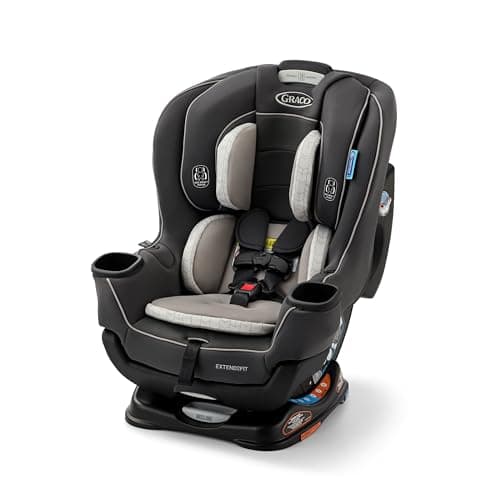
Graco Extend2Fit

Graco

Graco Extend2Fit
Our score8.9
Install8.6
Fit range9.6
Vehicle fit7.6
Daily use8.4
Value9.4
$239.99 · View on Amazon

#ad We may earn a commission · Price as of October 19, 2026

Rear-faces to 50 lb and adds up to 5 in of legroom with an extension panel, which is the cheapest route to the thing the AAP actually asks for.

The AAP's guidance is to keep a child rear-facing until they reach the highest weight or height their seat allows, and the practical obstacle is rarely the weight limit — it is a toddler's legs hitting the vehicle seat back, which makes parents turn the seat around early. The Extend2Fit attacks that directly: a 4-position panel extends the seat forward for up to 5 in of extra legroom, on top of a 4-50 lb rear-facing range. It is the least expensive way to buy real extended rear-facing. Forward-facing runs 26.5-65 lb, and there are six recline positions and ten headrest positions, so it adapts to awkward vehicle seats. The costs are bulk and basics: extending the panel eats front-to-back space, which can push the front passenger seat forward in a small car, and the fabrics and cup holders are plain. For most families this is the right convertible seat.

What works

  • 50 lb rear-facing limit plus an extension panel for legroom
  • Cheapest genuine extended-rear-facing seat here
  • Ten headrest positions cover a long growth span without rethreading

What to weigh

  • Extending the panel takes front-to-back space you may not have
  • Plain fabrics and hardware
  • No booster mode — this is a two-stage seat
Published specifications for the Graco Extend2Fit, with the source each figure was read from
SpecPublished figureRead from
Rear-facing4-50 lbGraco product page
Forward-facing26.5-65 lbGraco product page
Extension panel4 positions, up to 5 in extra legroomGraco product page
Adjustment6 recline positions, 10 headrest positionsGraco product page

Verified as currently sold and checked against NHTSA's recall record on 2026-09-26; no recall named this model. Recalls apply to specific manufacture-date ranges, so check the date stamp on your own unit. We do not print a star rating for this seat: NHTSA publishes an Ease-of-Use rating, and we would rather send you to the source than reprint a figure we could not read first-hand. Specifications come from the manufacturer or retailer listing.

03 — Staged fit from 4 lb

Chicco Fit4 4-in-1

Chicco

No image
Our score8.5
Install9.0
Fit range8.8
Vehicle fit7.4
Daily use8.6
Value8.2
Check price on Amazon

#ad We may earn a commission · Amazon shows the current price

An all-in-one that treats newborn fit as a design problem rather than an afterthought, with a layered insert system that comes out stage by stage.

The gap in most all-in-one seats is the newborn end: a shell built to hold a 60 lb child rarely holds a 7 lb one well. The Fit4's FitKit answers that with layers you remove as the child grows, and the Stage 1 positioner is required from 4-12 lb. The range runs rear-facing 4-40 lb, forward-facing 25-65 lb and booster 40-100 lb — 4-100 lb and up to 57 in overall. In exchange you get a seat that is large front to back and mid-to-upper priced, and the 40 lb rear-facing ceiling is ordinary rather than generous. Choose it if you want one seat from day one and would rather the newborn stage be properly supported than have the longest possible rear-facing limit.

What works

  • Layered insert system genuinely fits a newborn, unusual in an all-in-one
  • 4 lb minimum from day one
  • Four stages to 100 lb

What to weigh

  • 40 lb rear-facing ceiling is only average
  • Big front-to-back footprint
  • Mid-to-upper price for a mid-range range
Published specifications for the Chicco Fit4 4-in-1, with the source each figure was read from
SpecPublished figureRead from
Rear-facing4-40 lbChicco product page
Forward-facing25-65 lbChicco product page
Booster40-100 lbChicco product page
Overall range4-100 lb, up to 57 inChicco product page
Newborn supportStage 1 positioner required 4-12 lbChicco product page

Verified as currently sold and checked against NHTSA's recall record on 2026-09-26; no recall named this model. Recalls apply to specific manufacture-date ranges, so check the date stamp on your own unit. We do not print a star rating for this seat: NHTSA publishes an Ease-of-Use rating, and we would rather send you to the source than reprint a figure we could not read first-hand. Specifications come from the manufacturer or retailer listing.

Those three cover the two routes. The Chicco KeyFit 35 is the infant-seat answer: 4-35 lb up to 32 in, a bubble level and a belt tightener you crank rather than yank. The Graco Extend2Fit is the convertible answer, rear-facing to 50 lb with up to 5 in of extra legroom from its extension panel. The Chicco Fit4 is the compromise — an all-in-one with a staged fit from 4 lb, for the family that wants to buy once.

When skipping the infant seat makes sense

The infant carrier is the default recommendation and it is a good one, but there are households where it is the wrong purchase, and they are more common than the baby aisle implies.

  1. 1.You rarely drive. If the car is a weekend object, the carrier's daily convenience never materializes and you have bought a year-long seat for occasional use.
  2. 2.You already own a stroller you like that has no adapter for any carrier. The click-on is half the value; without it the maths changes.
  3. 3.You are on a tight budget. One convertible covering four years beats a carrier plus a convertible, and a cheap convertible is not a less safe convertible — see best budget car seats.
  4. 4.Your baby is large at birth. A 10 lb newborn uses up an infant seat's range noticeably faster, and the height limit may arrive before the first birthday.
  5. 5.You use a baby carrier for walks. If the baby travels on you rather than in a frame, the stroller click-on is irrelevant — the comparison there is car seat vs baby carrier.

If you buy the infant seat, when do you replace it?

The infant seat is finished when the baby reaches either the weight limit or the height limit, whichever comes first, and it is almost always height. The standard rule is that the child's head must stay at least one inch below the top of the shell — the Graco SnugRide SnugFit LX states exactly that. When either limit arrives, the child moves to a convertible and keeps rear-facing in it. Turning forward is a separate decision that happens much later, and is covered in how long should a child rear-face.

If you want the full stage map rather than this one decision, what size car seat does my child need lays out all four stages with the numbers, and when to switch car seat stages covers each transition.

Frequently asked questions

Is an infant car seat or a convertible better for a newborn?

Both are safe for a newborn as long as the seat's lower limit covers your baby. The infant seat is better if you want to carry a sleeping baby out of the car or click the seat onto a stroller. The convertible is better value because it lasts four to six years instead of about one.

Can a newborn go straight into a convertible car seat?

Yes, provided the model's published lower limit covers your baby's weight and height — many convertibles start at 4 or 5 lb. Get the recline angle right, which matters more for a newborn than at any other stage, and check that the harness slots sit at or below the shoulders.

How long does an infant car seat last?

Typically about a year. The limits are usually 30-35 lb and 32 in, and most babies reach the height limit first. The common rule is that the head must stay at least one inch below the top of the shell, so check that rather than only watching the scale.

Do I need both an infant seat and a convertible?

Most families end up with both, because the infant seat's convenience is worth it for the first year and the convertible is required after. You do not have to. Starting with a convertible and never owning a carrier is a legitimate plan, and it is the cheaper one.

Is a convertible car seat less safe than an infant seat?

No. Both are certified to the same federal standard. An infant carrier's shell and insert are sized for a small baby, which can make a good fit easier to achieve, but a correctly installed convertible with the harness set properly is equally appropriate from birth.

What about an all-in-one instead?

An all-in-one covers rear-facing, forward-facing and booster stages in one seat, which is the cheapest route over ten years. The trade is that it is never the best version of any single stage, and like a convertible it does not come out of the car. The Chicco Fit4 is the staged-fit option we rank.