
Skip to content
By Janet H., Owner, Janet Media GroupPublished How we research

Reviews

Britax Poplar S review

Narrow seats normally get narrow by cutting the rear-facing range, and ClickTight seats are normally wide. This one refuses both trades — and the question is what it costs you instead.

A convertible car seat installed in the back seat of a vehicle

Buckle & Buggy earns a commission when you buy through links on this page, at no extra cost to you. It does not change what we recommend or the order we rank things in — the criteria are published on our review methodology page, and the full terms are in our affiliate disclosure.

The short version

There is a specific, common, and genuinely difficult car seat problem that almost no product solves well: you need to rear-face a child for years, and you also need the back seat to hold something else — a third car seat, a third passenger, or an adult who has to sit next to the thing without riding sideways.

The reason it is difficult is that the two requirements normally pull against each other. A seat that rear-faces to 50 lb needs a tall shell and a deep base, and manufacturers buy that capacity with width. Seats marketed as narrow usually get there by lowering the rear-facing limit to 40 lb, which gives up exactly the years you were trying to keep. And ClickTight — Britax's belt-threading install, which is the easiest correct installation in the category — has historically lived only in the brand's wider seats.

The Poplar S is the seat that declines to pick. Britax publishes a 17 in width, rear-facing 5-50 lb and 18-49 in, forward-facing 30-65 lb and 35-49 in, and ClickTight doing the belt tensioning. On paper that is close to the ideal answer for a crowded back seat, and in the narrow-seat market it is unusual enough to be the reason to buy it.

What it costs you is money, a booster stage, and portability. It sits in the premium price band, which on a seat with no booster mode means you will buy something else at around 65 lb. And at 28.0 lb for the seat alone it is heavy — this is a seat you install once and leave, not one that travels between cars. If none of those three is your constraint, this is one of the best-aimed convertible seats on the market.

How we assessed it

We have not crash-tested this product and we do not own one. What we did is read the manufacturer's own specification page and manual, record every figure against the page it came from, check the model against NHTSA's recall database, and confirm it is currently sold — all on the date shown in the table below. Then we assessed it against the five criteria we apply to every product on this site.

For a convertible seat we weight fit range and vehicle fit most heavily, because the whole point of the category is buying years at a time, and because a seat that will not physically fit your back seat is not a candidate at any price. We read the published weight and height ranges for both directions, the shell and shoulder widths, overall dimensions, seat weight, harness slot heights, recline positions, expiration period and fabric treatment from Britax's own product page on the date above, and confirmed the seat is currently sold there with an active add-to-cart. We also ran the model against NHTSA's 2026 Britax recall filing, which is covered in its own section below because the answer is more useful than a yes or no.

We do not print a NHTSA star rating or an IIHS category for this model. NHTSA publishes an Ease-of-Use rating and IIHS publishes booster belt-fit ratings, but both block automated access to their databases, so we could not read a figure from the primary source. Reprinting an unverified safety number on a page a parent may rely on is not a risk worth taking, so we link the official lookup tool instead. The full method is on the methodology page.

The full assessment

01 — Narrow shell plus ClickTight

Britax Poplar S

Britax
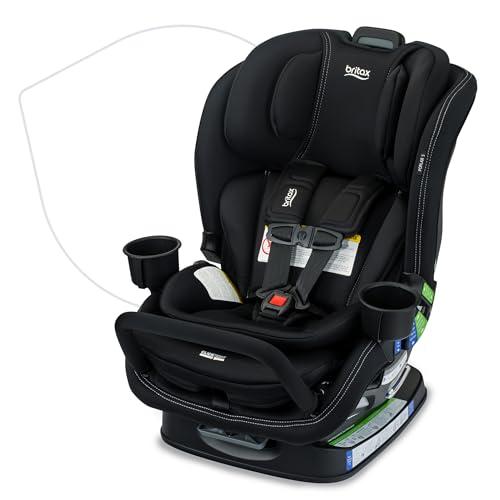
Britax Poplar S
Our score8.9
Install9.4
Fit range9.0
Vehicle fit9.4
Daily use8.4
Value7.2
$399.99 · View on Amazon

#ad We may earn a commission · Price as of November 10, 2026

A 17 in shell with ClickTight installation — the rare combination of 50 lb rear-facing and a footprint that works three across.

Narrow seats usually get narrow by shortening the range, and ClickTight seats are usually wide. The Poplar S is the seat that does not make you choose: 17 in across the shell, rear-facing 5-50 lb and 18-49 in, forward-facing 30-65 lb and 35-49 in, with ClickTight doing the belt tensioning. That makes it one of the few genuinely strong answers for a family who needs extended rear-facing and needs to fit a third seat or a third passenger in the back. Worth noting the 5 lb rear-facing minimum, which is fine for a full-term newborn but is not a preemie seat. It is priced in the premium band, and the harness pads and fabrics are good rather than exceptional. If your constraint is back-seat width, start here.

What works

  • 17 in wide with a full 50 lb rear-facing range
  • ClickTight makes the belt install the easy option
  • Realistic three-across candidate in a midsize car
  • 14 harness positions from 8 to 17 in, no rethreading
  • SafeWash fabrics are machine washable and dryable with no added flame retardants

What to weigh

  • Premium price
  • 5 lb rear-facing minimum — not a preemie seat
  • No booster stage
  • 28.0 lb seat — not one to move between cars
Published specifications for the Britax Poplar S, with the source each figure was read from
SpecPublished figureRead from
Rear-facing5-50 lb, 18-49 inBritax product page
Forward-facing30-65 lb, 35-49 inBritax product page
Shell width17 inBritax product page
Install systemClickTightBritax product page
Harness14 positions, 8-17 in, no-rethreadBritax product page
Recline6 positions, quick-adjustBritax product page
Seat weight28.0 lbBritax product page
Expiration10 yearsBritax product page

Verified as currently sold and checked against NHTSA's recall record on 2026-10-22; no recall named this model. Recalls apply to specific manufacture-date ranges, so check the date stamp on your own unit. We do not print a star rating for this seat: NHTSA publishes an Ease-of-Use rating, and we would rather send you to the source than reprint a figure we could not read first-hand. Specifications come from the manufacturer or retailer listing.

Why 17 inches and 50 pounds is the whole story

Shell width is the specification that decides whether a seat is a candidate for you, and it is the one most buyers never look up. Three car seats across a typical midsize back seat is an arithmetic problem before it is a shopping problem: you have roughly 50 to 55 in of usable bench, minus the buckle stalks and the contour of the bench itself, and anything wider than about 17 in per seat stops fitting in threes almost immediately.

Britax publishes 17 in for the Poplar S and describes it as a slim design intended to fit three across, with the standard and correct caveat that no manufacturer can guarantee fitment in every vehicle. The figures underneath that are what make it credible rather than marketing: a 14 in shoulder width and overall dimensions of 20.5 by 17 by 23.5 in. The 20.5 in front-to-back depth is the number to check against your own car, because rear-facing depth is what pushes the front seats forward and it is the dimension that most often ends a three-across plan.

Here is the part that matters. Britax did not pay for that width by shortening the rear-facing range. The published rear-facing span is 5-50 lb and 18-49 in — a full 50 lb ceiling, which is the top of the mainstream convertible market and enough to rear-face a typical child into the fourth year. Narrow seats that stop rear-facing at 40 lb are asking you to trade away the thing that extended rear-facing is for. This one does not, and that combination is rare enough that it is effectively the product.

Two honest qualifications. First, the 5 lb rear-facing minimum is fine for a full-term newborn but is not a preemie seat; if you are planning for a small or early baby, an infant seat with a 4 lb minimum is the safer plan. Second, the 49 in height limit applies in both directions, and height is what usually ends a stage rather than weight — the governing rule is the one printed in the manual, normally at least an inch of shell above the top of the head rear-facing, and ears below the top of the shell forward-facing. Our guide to how long a child should rear-face covers why the limit is worth using up, and how many car seats fit in my car is the page to read before you commit to a three-across layout.

What ClickTight actually changes

ClickTight is the feature the Britax premium is attached to, so it is worth describing what it does rather than repeating the brand name.

In a conventional belt installation you route the vehicle seat belt through a belt path on the side of the shell, buckle it, lock it, and then remove the slack by pushing down on the seat with your body weight while hauling on the belt. It works, and it is where most bad installations come from, because the amount of force required is unintuitive and the test — less than an inch of movement at the belt path — is something you check after the fact and often fail.

ClickTight replaces that with a mechanical step. Britax describes the install as three actions: open, thread and buckle, close. You swing open a panel in the front of the seat, lay the belt flat across an exposed path, buckle it with no tensioning at all, and then close the panel — and closing the panel is what tensions the belt, using leverage rather than your back. The install stops depending on how strong you are or how determined you are feeling, which is the entire point.

That matters more on this seat than it would on a wider one, because the hardest installs are the ones in the middle of a crowded bench where you cannot get your shoulders over the seat to push down. A seat designed for three across that also removes the need to lean on it is a coherent piece of design. The mechanics of both install methods are in how to install a car seat, and the printable installation checklist is the version to keep in the glovebox.

The daily-use hardware around it is also good, and it is worth naming because this is where a premium seat earns its keep over four years rather than four minutes. Britax publishes a 14-position quick-adjust headrest and harness running from 8 in to 17 in, with no rethreading — you move the harness height and the headrest together as the child grows instead of dismantling the seat. There are 6 quick-adjust recline positions, buckle strap depths from 4 in to 7 in, two infant inserts, and two removable cup holders Britax states are dishwasher safe. The fabrics are the brand's SafeWash material: machine washable and dryable, and naturally flame-retardant with no added FR chemicals, which is a published materials claim rather than a crash-performance one and should be read that way.

The 2026 Britax recall, and why it does not apply here

If you search this brand you will find a large 2026 recall, and because it is large it is worth being precise about what it covers — the honest answer is useful in both directions.

NHTSA's Part 573 report 26C006 lists Britax Child Safety, Inc. and a potential population of 114,660 units. The defect is in the carrying handle of the company's infant carriers: a screw at the handle hub mount can loosen, allowing the handle to partly detach. The filing followed a consumer complaint alleging a handle hub mount detached and caused a minor injury, and Britax's own review of field and warranty data identified 217 reports of handle detachment and a further 312 of the handle being loose or wobbling.

The models named are B-SAFE 35, B-SAFE ULTRA, ENDEAVOURS, B-SAFE GEN 2, B-SAFE GEN 2 FLEXFIT and B-SAFE GEN 2 FLEXFIT PLUS. Every one of them is a rear-facing-only infant carrier with a carrying handle. The Poplar S is a convertible seat that has no carrying handle and is not on the list, so the defect described in the filing is not present on this product.

One genuine piece of good news on longevity: Britax publishes a 10-year expiration from manufacture on this seat, at the generous end of the category, which matters if a second child is likely inside that window. The manufacturer warranty is a separate and much shorter thing — one year limited. Do car seats expire explains why the date exists and why it is not marketing.

Who should buy it, and who should not

  • Anyone trying to fit three car seats across one bench. This is the case the seat is designed for, and 17 in with a 50 lb rear-facing limit is a genuinely unusual combination. Check the 20.5 in depth against your own car first.
  • Anyone who intends to rear-face as long as possible but cannot give up the back-seat width to do it. The 50 lb ceiling is the whole reason to pay for this rather than a 40 lb narrow seat.
  • Anyone who has installed a car seat badly before, or who will be installing in a tight middle position. ClickTight removes the step where installations go wrong, and it does not require you to be strong.
  • Families who will wash the cover often — SafeWash fabrics are rated machine washable and dryable, which sounds trivial until the first stomach bug.

Who should not: anyone who wants one seat to cover every stage. The Poplar S harnesses to 65 lb and then stops, with no booster mode, so there is another purchase waiting at the end of it — if that is your plan, an all-in-one is the better shape of product and our Britax One4Life review covers the brand's own version, with the wider category in best all-in-one car seats. Anyone moving a seat between two cars weekly, because 28.0 lb and a belt-threading install is the wrong combination for that life. Anyone buying for a preemie, given the 5 lb minimum. And anyone whose budget is the binding constraint, because the Poplar S is priced firmly in the premium band and a correctly installed cheaper seat protects a child perfectly well — best budget car seats is the honest version of that list.

For category context, best convertible car seats ranks this seat against the rest of the stage, and best car seats for small cars sorts on footprint and install behavior rather than features. If you are deciding between brands rather than models, Britax vs Chicco car seats sets out what each one actually sells you.

Frequently asked questions

Does the Britax Poplar S fit three across?

It is one of the better candidates for it. Britax publishes a 17 in width and describes the seat as designed to fit three across, while stating — correctly — that fitment in every vehicle cannot be guaranteed. The figure to check against your own car is the 20.5 in front-to-back depth, because rear-facing depth is what pushes the front seats forward and is the dimension that most often defeats a three-across plan. Buckle stalk positions and bench contour decide the rest, so measure before you buy three of anything.

How long can a child rear-face in the Poplar S?

Britax publishes rear-facing limits of 5-50 lb and 18-49 in. A 50 lb ceiling is the top of the mainstream convertible market and will rear-face a typical child well into the fourth year, which is the point of buying it over a narrow seat that stops at 40 lb. In practice height usually ends the stage before weight does, and the governing rule is the one in the manual — normally at least an inch of shell above the top of the child's head.

Does the Poplar S turn into a booster seat?

No. It is a two-stage convertible: rear-facing 5-50 lb, then forward-facing with the 5-point harness to 65 lb, and that is where it ends. There is no belt-positioning booster mode, so a separate booster purchase is coming at around 65 lb or 49 in. If you would rather buy once, an all-in-one covers harness and booster in the same shell, usually in a wider body and at a higher price.

What is the difference between ClickTight and a normal belt install?

In a conventional install you thread the belt through a side belt path and then remove the slack by pressing down on the seat while pulling the webbing, which is where most bad installations come from. With ClickTight you open a panel in the front of the seat, lay the belt flat, buckle it without tensioning, and close the panel — closing it is what tightens the belt, using leverage instead of your body weight. The practical result is that a correct install stops depending on how strong you are.

Is the Britax Poplar S affected by the 2026 Britax recall?

No. NHTSA's report 26C006 covers 114,660 Britax infant carriers — B-SAFE 35, B-SAFE ULTRA, ENDEAVOURS, B-SAFE GEN 2, B-SAFE GEN 2 FLEXFIT and B-SAFE GEN 2 FLEXFIT PLUS — for a screw at the carrying handle hub mount that can loosen and let the handle partly detach. The Poplar S is a convertible seat with no carrying handle and is not named in the filing. Recall status is only true on the day it is checked, so look your own model up before you install it.

How much does the Poplar S weigh?

Britax publishes 28.0 lb for the car seat alone. That is heavy, and it is the clearest reason not to buy this seat if you move seats between cars — a belt-threading install on a 28 lb shell is a two-handed job you will resent weekly. For a seat that goes in once and stays, the weight is irrelevant and the install quality is what you actually live with.

When does the Britax Poplar S expire?

Britax publishes a 10-year expiration from the date of manufacture, which is at the generous end of the category and is stamped on the seat rather than tied to your purchase date. That is long enough to cover a second child in most families, which is a real part of the value on a premium seat. The manufacturer warranty is separate and much shorter at one year limited.